 Skip to content

Updated for 2026 | A no-fluff answer guide for anyone asking candy gas strain questions before they buy, grow, or smoke it
I get the same messages every week. Someone smells a jar at the dispensary, sees “Candy Gas” on the label, and texts me a photo with one question: “wait, what even is this?” 🤔 So I put together this candy gas FAQ to answer that question once and for all, along with every other thing people ask me about this strain.
This isn’t a copy-paste strain profile. I pulled real grower notes, real dispensary listings, and real reviews from Leafly, Weedmaps, and grower forums to put this together. Where sources disagree (and they do, a lot), I’ll tell you that too. Candy Gas is a strain with a messy, disputed backstory, and honestly, that’s part of what makes it interesting. Let’s get into it. 👇
A quick heads up before we start: you’ll notice I don’t give you one single, tidy answer for everything. That’s on purpose. Candy Gas isn’t like an old, stable strain that’s been grown the same way by the same handful of breeders for twenty years. It’s a newer, trendier name that different growers apply to slightly different plants, all chasing the same flavor idea. So instead of pretending there’s one perfect answer to every question, I’m going to show you the real range of what’s out there and help you make sense of it. That’s a lot more useful than a made-up number that sounds clean but doesn’t match what you’ll actually find on a dispensary shelf.
📋 What’s covered in this candy gas FAQ
- What is the Candy Gas strain, exactly?
- Is Candy Gas indica, sativa, or hybrid?
- Where does Candy Gas actually come from?
- Why can’t anyone agree on the lineage?
- Is Gas Candy the same thing as Candy Gas?
- Why did this candy-and-gas trend even start?
- How strong is Candy Gas? What’s the THC percentage?
- Does Candy Gas have any CBD in it?
- What does Candy Gas smell like?
- What does Candy Gas taste like?
- What terpenes make the candy-and-gas combo happen?
- What effects should I expect?
- How long do the effects last?
- What’s the best way to smoke or use it?
- How strong are Candy Gas concentrates and extracts?
- What time of day works best for it?
- Will it make me hungry?
- Will it show up on a drug test?
- Is Candy Gas okay for beginners?
- Are there side effects I should know about?
- Is Candy Gas good for anxiety, or could it make it worse?
- How much does Candy Gas cost?
- Why is it priced higher than a lot of other strains?
- Can I grow Candy Gas myself?
- How long does it take to flower?
- What kind of yield can I expect?
- How should I store it to keep the smell fresh?
- Is Candy Gas legal where I live?
- What’s the difference between THC flower and THCa flower versions?
- Where can I actually buy it?
- How do I know I’m getting the real thing?
- How does it compare to similar strains?
- What do real users actually say about it?
- Is Candy Gas worth trying?
⚡ Quick answer, if you’re in a hurry
Candy Gas is a hybrid weed strain that mixes a sweet, fruity candy smell with a heavy diesel-fuel funk underneath. THC usually falls somewhere between 20% and 30%, depending on the batch and grower. It’s a 50/50 balanced hybrid on paper, though most real-world cuts lean slightly indica in how they feel. Expect a happy, clear-headed rush at first that melts into a relaxed body high about 20 to 30 minutes in. Price sits in the upper-mid range, usually $10 to $17 a gram. Now let’s get into the details.
🍬 What is the Candy Gas strain, exactly?
Candy Gas is a hybrid cannabis strain built around one idea: take a dessert-sweet candy smell and slam it against a heavy, gassy diesel funk. That contrast is the whole point of the strain. You crack the jar and get hit with fruit punch or grape candy, and then a second later your nose picks up something closer to a mechanic’s garage. It sounds like it shouldn’t work. It does.
The name has become a bit of a category more than a single fixed strain. Different breeders and dispensaries use “Candy Gas” to describe slightly different genetics, but they’re all chasing the same sensory target: candy up front, gas on the back end. Weedmaps lists it as a balanced hybrid with relaxing indica traits and an invigorating sativa lift, which lines up with what most people report after smoking it.
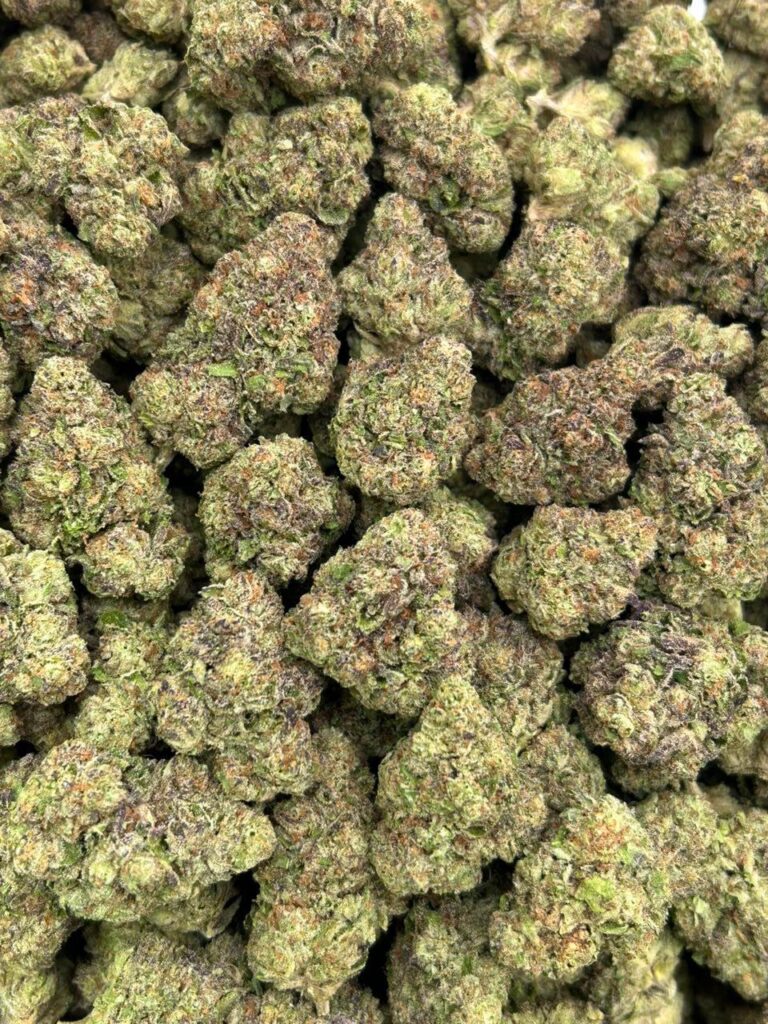
Visually, it’s a good-looking strain. Buds tend to be dense and chunky, with a base of deep green or olive, purple undertones running through the calyxes, and bright orange hairs woven throughout. A thick coat of trichomes gives the whole bud a frosted, almost sugar-dusted look. That’s not an accident either. Growers who chase the “Candy Gas look” are specifically selecting for that frosty, photogenic appearance because it sells on sight before anyone even opens the bag.
⚖️ Is Candy Gas indica, sativa, or hybrid?
Officially, Candy Gas is listed as a 50/50 hybrid, right down the middle between indica and sativa. Leafly’s strain page confirms this even split, and most dispensary listings repeat the same number.
But here’s the thing I’d tell a friend on the phone: the “50/50” label doesn’t always match the actual experience. A lot of real user reviews describe Candy Gas leaning indica once the high settles in. You get an energizing, clear head rush in the first few minutes, and then your body starts to sink into the couch while your mind stays pretty functional. One Leafly reviewer put it well, saying the high felt like “a good balance between euphoric and chill” that never fully knocked them out.
So if you’re picking Candy Gas expecting a pure sativa daytime buzz, temper that expectation. It’s better described as a hybrid that starts sativa and finishes indica. That makes it flexible. You can smoke it in the afternoon and still get things done, or smoke it at night and let the body high take over once the head rush fades.
🧬 Where does Candy Gas actually come from?
This is probably the single most common candy gas strain question I get, and the honest answer is: it depends who you ask. There are two competing origin stories that show up again and again.
Story one: Crockett Family Farms. Most retail listings, including Leafly and Weedmaps, trace Candy Gas (sometimes labeled Gas Candy) back to a cross of Kandy Kush and OG #18, bred by Crockett Family Farms. This version tests around 20% THC on average and carries a sweet, gassy, hazelnut-leaning aroma.
Story two: Grounded Genetics. A separate lineage, documented by SeedsHereNow and seed banks like Linda Seeds, says Grounded Genetics created their version of Candy Gas by reversing a Bacio Gelato cut (a Gelato 41 phenotype) to get pollen, then using that pollen to fertilize a prized Runtz cut. This version tends to run higher in THC, sometimes into the high 20s or low 30s, and leans harder into the fruity, dessert-forward candy notes.
On top of those two, Beard Bros Pharms notes that some phenotypes trace back to Runtz, Zkittlez, and OG-leaning hybrids more broadly, without one locked-in family tree. Nobody’s lying here. Cannabis breeding is messy, cuts get passed around, and once a flavor profile gets popular, multiple breeders start chasing it under the same catchy name.
❓ Why can’t anyone agree on the lineage?
Because “Candy Gas” describes a smell and a vibe more than it describes one fixed genetic line. Think of it less like a single strain and more like a style, the same way “IPA” describes a type of beer instead of one specific recipe. JointCommerce’s strain guide puts this nicely, framing Candy Gas as a contemporary cultivar name used across multiple breeder programs rather than one universally accepted genotype.
What ties every version together isn’t a shared parent plant. It’s a shared terpene goal: dessert-sweet top notes (usually from limonene, linalool, and ocimene) layered over a gassy, caryophyllene-heavy base that echoes classic OG and diesel genetics. So when you buy Candy Gas, you’re really buying a flavor promise, not a guaranteed family tree. That’s why checking the lab label and grower name matters more with this strain than with older, more stable cultivars.
🔁 Is Gas Candy the same thing as Candy Gas?
Yes, in almost every case. You’ll see both names used, and they usually point at the same plant. Leafly’s own strain page lists it as “Gas Candy, also known as Candy Gas,” and treats the two names as interchangeable. Dispensaries and breeders flip the word order depending on their own branding preference, not because the plant changes.
That said, once you’re shopping across multiple dispensaries, don’t assume every “Gas Candy” or “Candy Gas” jar on every shelf is the exact same cut. Because the name covers more than one lineage (remember, there’s a Crockett Family Farms version and a Grounded Genetics version, plus assorted regional phenotypes), the word order isn’t a reliable signal of genetics. Read the breeder name and lab sheet if you want to know exactly what you’re getting, and don’t put too much weight on whether the label says “Gas Candy” or “Candy Gas.” They’re the same idea wearing two different name tags.
📜 Why did this candy-and-gas trend even start?
If you smoked weed ten or fifteen years ago, the popular strains smelled pretty different. Think earthy, piney, skunky names like OG Kush, Sour Diesel, and Chemdog. Those “gas” strains built cannabis’s reputation for a heavy, fuel-like funk, and they’re still respected for that reason today.
Then, around the mid-2010s, a new wave of strains flipped the script on flavor. Lucky Elk’s rundown traces this shift back to Zkittlez, a cross of Grape Ape and Grapefruit bred by 3rd Gen Family and Terp Hogz, which introduced a bright, juicy, almost artificial candy sweetness that cannabis hadn’t really leaned into before. Runtz followed soon after (a Zkittlez x Gelato cross) and became one of the most recognized names in modern cannabis, even winning Leafly’s Strain of the Year in 2020.
Once breeders saw how much people loved that candy-forward flavor, the natural next move was combining it with the punchy, heavy gas genetics that had defined cannabis for the previous decade. Crossing a dessert-sweet strain with a diesel-heavy one gave breeders the best of both trends in a single plant. Candy Gas is one of the clearest examples of that crossover, and it’s part of a bigger wave of “candy gas” style strains, including Candy Fumez, Gas Station Candy, and Purple Candy Gas, all chasing the same sweet-then-fuel formula. In a lot of ways, Candy Gas isn’t just a strain. It’s a snapshot of where cannabis breeding trends were heading in the mid-2020s. 📈
🔥 How strong is Candy Gas? What’s the THC percentage?
This is where the range gets wide, and it’s one of the biggest candy gas strain questions people bring to me. Numbers I found across dispensary listings and lab sheets run from about 19% all the way up to 30%, sometimes higher on THCa flower labels.
- Leafly’s base listing puts Gas Candy at 20% THC.
- A reviewer on Leafly’s reviews page tested a 7 Wonders brand batch at 19.17% THC.
- OKC Clone Nursery lists Candy Gas potency up to 29%.
- Green Unicorn Farms sells a Candy Gas THCa flower rated over 21% THCa.
- Ounce of Hope lists a batch at 30.8% THCa.
So which number is real? Honestly, all of them, because they’re all different batches from different growers. THC percentage depends on the specific cut, growing conditions, harvest timing, and which lab did the testing. If a listing seems way higher than everything else you’ve seen, don’t assume it’s fake, but don’t assume it’s gospel either. Ask to see the actual certificate of analysis (COA) if the dispensary has one on hand. That’s the only number you can trust completely.
One more thing worth knowing going into 2026: lab testing across the legal cannabis industry has faced real scrutiny over inflated THC numbers, since some labs compete for business by reporting higher potency than a flower actually contains. If a strain’s THC number seems too good to be true, it might be. Judge the strain by how it hits you, not just by the number on the label.
🌿 Does Candy Gas have any CBD in it?
Not much. Most listings, including SunWest Genetics’ seed page, put CBD around 2% or less. OKC Clone Nursery lists CBD potency as “insignificant.” So Candy Gas is bred and grown for THC content and terpene expression, not for a balanced CBD ratio. If you’re looking for a strain with real therapeutic CBD levels for pain or anxiety without a heavy psychoactive punch, Candy Gas isn’t built for that job. It’s a THC-forward flavor strain through and through.
If CBD is a priority for you, look instead for strains specifically bred for a 1:1 or higher CBD-to-THC ratio, like Harlequin, ACDC, or Cannatonic. Candy Gas can still offer some indirect relief through its relaxing body effects and mood lift, but that comes from THC and the surrounding terpene profile, not from any meaningful CBD content. Worth knowing before you buy it expecting a gentler, low-intoxication experience.
👃 What does Candy Gas smell like?
This is the part people talk about most, and for good reason. The smell is the whole identity of this strain. Crack open a jar and you’ll usually get an immediate rush of something sugary and artificial-sweet, like grape candy, sour candy apple, or a Jolly Rancher. One reviewer on Leafly described it as a “unique grape candy scent,” while another said it smelled like sweet Pixy Stix or the candy dip stick from Fun Dip.
Then, right underneath that sugar-sweet top note, there’s a heavy gassy backend. Think diesel fuel, skunk, and a little bit of pepper. Asheville Dispensary’s product page describes the smell as sweet, buttery, and diesel all at once. It’s a genuinely weird combo the first time you smell it, sweet and funky at the same time, but it’s exactly what makes the strain memorable. 🍇⛽
👅 What does Candy Gas taste like?
The taste usually mirrors the smell but softens a bit on the exhale. Most reviewers describe a fruity, candy-sweet inhale that gives way to a gassy, diesel-forward exhale. One Leafly reviewer who tried a distillate cart said the taste reminded them of sweet Pixy Stix, while another described the smoke overall as smooth without much harshness, just a strong diesel punch right at the end.
Some growers report a creamy, almost marshmallow undertone showing up in certain phenotypes, which softens the gas without hiding it. Green Unicorn Farms describes exactly that kind of creamy note layered under the candy and fuel. So the exact taste can shift a bit depending on which Candy Gas cut you land on, but sweet-then-gassy is the constant thread across every review I found.
🧪 What terpenes make the candy-and-gas combo happen?
The flavor split comes down to terpene chemistry, and it’s actually a cool answer if you’re into the science side of cannabis. The “candy” half usually comes from limonene (citrus and candy-sweet), linalool (floral, slightly sweet), and ocimene (herbal-sweet). The “gas” half comes mostly from beta-caryophyllene, a peppery, spicy terpene closely tied to OG and diesel genetics, along with trace sulfur compounds that create that classic skunky, fuel-like edge.
SeedsHereNow’s breakdown calls beta-caryophyllene the anchor terpene of the whole profile, running somewhere between 0.3% and 0.9% depending on the batch. Meanwhile, Weedmaps points to limonene and caryophyllene as the main duo responsible for that funky-fruit-and-diesel combination people keep coming back for. Well-grown batches often hit total terpene levels above 2%, sometimes reaching 3% to 4% in top-shelf indoor drops, which is a big reason the smell hits so hard the moment you open the container.
😌 What effects should I expect?
Most people describe a two-stage experience with Candy Gas. First comes a quick, uplifting head change, sometimes described as euphoric or clear-headed, that hits within a couple of minutes. Then, over the next 15 to 30 minutes, a relaxed body high creeps in and takes over without fully knocking you flat. One reviewer on Leafly called it a “solid head change at first” that “melted into a relaxed body high without completely knocking me out.”
Common effects reported across reviews include:
- 😊 A fast mood lift and sense of calm happiness
- 🧘 Muscle relaxation that builds gradually rather than hitting all at once
- 💬 A social, talkative window in the first 30 to 45 minutes for some users
- 😴 Drowsiness later in the session, especially at higher doses
- 🍕 Increased appetite for a decent number of users
GrowDiaries adds that medicinal users report real benefit for stress, anxiety, and low mood, thanks to that early uplifting phase before the body relaxation sets in. So this isn’t a strain that just knocks you out. It gives you a window of clear-headed good mood before things mellow out.
⏱️ How long do the effects last?
Most flower-based sessions with Candy Gas run about 2 to 3 hours from onset to comedown, which is fairly typical for a mid-to-high THC hybrid. The head high usually shows up within the first 5 to 10 minutes, peaks somewhere around the 30 to 45 minute mark, and then eases into the body-relaxation phase for the rest of the session. Concentrates and vape carts made from Candy Gas hit faster and can feel more intense right out of the gate, so if you’re using a distillate cart or a live resin dab, start with a smaller amount than you would with flower.
🔥 What’s the best way to smoke or use it?
It genuinely depends on what you’re after. A joint or hand pipe gives you the most balanced, full-flavor experience, since you get the whole candy-then-gas arc from inhale to exhale without anything getting filtered out. A bong or bubbler cools the smoke down and smooths out the harshness, which some reviewers say makes the diesel backend less sharp on the throat, though you also lose a bit of the aromatic punch to the water.
Vape carts and distillate, like the one described in a Leafly review that compared the taste to sour candy apple and Pixy Stix, tend to push the candy notes forward more than the gas, since a lot of the heavier, skunkier terpenes don’t always survive the distillation process. If you want maximum gas funk and the full raw terpene experience, flower is going to beat a vape cart every time. If you want something more portable and discreet with a sweeter edge, a cart is the easier choice. Dabs and concentrates hit the hardest and fastest of all, since THC in extracts made from Candy Gas can climb well above 70%, so pace yourself if you’re going that route.
💨 How strong are Candy Gas concentrates and extracts?
A lot stronger than flower, which makes sense once you think about how extraction works. Concentrates strip away plant material and water weight, leaving behind a much more concentrated dose of cannabinoids and terpenes. According to JointCommerce’s strain guide, THC in concentrates made from Candy Gas genetics often exceeds 70%, and can surpass 80% in hydrocarbon extracts like butane hash oil.
Live resins and rosins that hold onto 3% to 6% terpenes by weight keep the candy-and-gas character vivid, sometimes even more intense than flower, since the extraction process concentrates the aromatic oils along with the THC. That combination hits harder and faster than smoking flower. If you’re used to flower and want to try a Candy Gas concentrate for the first time, start with a much smaller amount than you’d normally use, and give it extra time to kick in before deciding you need more. Dabs in particular can catch people off guard, since the onset is nearly instant and the peak intensity arrives within a minute or two.
🌗 What time of day works best for Candy Gas?
Given the two-stage effect (an uplifting head rush followed by body relaxation), Candy Gas works well in a few different windows depending on how much you use and when. A small amount in the early afternoon can give you that clear-headed lift without tipping into heavy body relaxation right away, which some users find works for social situations or light creative tasks. A bigger dose in the evening lets the full arc play out, ending in the kind of couch-friendly relaxation that’s better suited to winding down than getting things done.
What I wouldn’t recommend is a strong dose right before something that needs your full attention, like driving or operating machinery. The early clear-headed phase can feel deceptively functional, but the body relaxation that follows can catch up with you fast, especially with a higher-THC batch. Treat Candy Gas the way you’d treat any strong hybrid: plan your dose around what you actually need to do for the next few hours, not just around how good it smells in the jar. 🕐
🍟 Will it make me hungry?
For a decent number of users, yes. Increased appetite shows up repeatedly in user reports as one of the effects during the body-relaxation phase of the high. This tracks with what’s generally known about THC and appetite, since THC interacts with receptors in the brain that regulate hunger signals. If you’re using Candy Gas for appetite support, that later, more indica-leaning stretch of the high is usually when the munchies kick in hardest, not the early clear-headed phase. If you’d rather avoid the munchies altogether, a smaller dose and stopping once you hit that early euphoric window can help you dodge the appetite spike.
🧪 Will it show up on a drug test?
Yes. Candy Gas is a THC-rich strain, and standard drug tests screen for THC metabolites, not for specific strain names. It doesn’t matter whether you smoke Candy Gas, any other strain, or a THCa product that converts to THC when heated. If it gets you high, THC and its metabolites will be detectable in your system for a period of time afterward, generally a few days for occasional users and considerably longer for frequent or heavy users, since THC metabolites store in body fat. If you’re facing a drug test of any kind, the only sure way to avoid a positive result is to not use THC products at all in the window before testing.
🔰 Is Candy Gas okay for beginners?
It can work for beginners, but go in with a plan. Because THC percentage on Candy Gas often lands in the 20% to 30% range, it’s on the stronger side compared to a lot of older, more classic strains that test closer to 15%. That’s not a reason to avoid it as a new smoker, but it is a reason to be careful with dose.
If you’re new to cannabis, try one or two small puffs from a joint or pipe, then wait a full 15 to 20 minutes before deciding whether to smoke more. Skip the dab rig and heavy concentrates until you know how your body handles regular flower first. Leafly itself notes that Gas Candy’s THC level makes it “an ideal choice for experienced cannabis consumers,” which is a fair heads up. Experienced smokers can enjoy Candy Gas without much thought, but newer users should treat the strength with real respect.
⚠️ Are there side effects I should know about?
Yes, and they’re pretty standard for a mid-to-high THC hybrid. Herb’s 2026 strain guide lists dry mouth and dry eyes as the most common complaints. At higher doses, especially for people with lower THC tolerance, dizziness and mild paranoia can show up. GrowDiaries lists the same basics: anxiousness, dry mouth, dry eyes, and dizziness as the main downsides people report.
None of this is unusual for cannabis in general, but it’s worth repeating here because Candy Gas often tests on the stronger side of the THC spectrum. If you’re new to cannabis or have a lower tolerance, start with a small amount (a couple of small puffs, not a full bowl) and wait 15 minutes before deciding whether to smoke more. You can always take more. You can’t take less once it’s in your system.
🧠 Is Candy Gas good for anxiety, or could it make it worse?
Both, depending on the person and the dose. At lower doses, the early euphoric lift that Candy Gas is known for can genuinely ease stress and anxious thoughts, which is why several reviewers and grow diary logs mention it helping with stress and low mood. But at higher THC percentages, especially with the stronger THCa flower batches that test near 30%, some users report the opposite: racing thoughts or mild paranoia, particularly if they’re new to cannabis or already feeling anxious before they smoke.
If anxiety is your main reason for trying Candy Gas, treat it carefully. Start low, go slow, and pay attention to how your body responds in that first 20 minutes. If you notice your heart rate climbing or your thoughts spiraling, that’s your body telling you to stop for the night, not push through.
💵 How much does Candy Gas cost?
Prices vary by state, dispensary, and whether you’re buying flower or THCa product, but here’s the real range I found across current listings:
| Source | Price | Product type |
|---|---|---|
| Leafly | $10 to $15 per gram | Flower |
| Zaza Distro | $10 to $15 per gram | Flower |
| Herb (2026 guide) | $11 to $17 per gram | Flower, upper-mid to premium tier |
| Green Unicorn Farms | $99 per ounce | Top-shelf THCa flower |
| Ounce of Hope | $18 to $266 (tiered) | THCa flower, multiple sizes |
So a fair general rule: expect somewhere between $10 and $17 a gram for standard flower, with THCa specialty drops sometimes running higher per gram in smaller quantities and cheaper per gram in bulk ounces. Craft, small-batch indoor grows sit at the top of that range. Bulk or budget cuts sit at the bottom and can look less vivid and smell less loud, according to Herb’s pricing breakdown.
💰 Why is it priced higher than a lot of other strains?
Three reasons, really. First, it’s genuinely harder to grow well. Getting both the candy sweetness and the gas punch to show up strongly in the same crop takes careful breeding and precise environmental control, which costs growers more time and money. Second, the bag appeal is strong. Those frosty, purple-tinted, trichome-covered buds photograph beautifully, and dispensaries know a strain that looks good on Instagram sells itself. Third, demand for the “candy gas” flavor category has stayed high across the industry, and pricing tends to track demand more than it tracks actual production cost.
There’s also a simple supply reason. Because Candy Gas isn’t one single, stable, mass-produced clone controlled by one massive grow operation, it tends to come from smaller and mid-size cultivators chasing a specific phenotype. Smaller batch sizes usually mean higher per-gram costs compared to a strain grown at industrial scale by a handful of huge brands. So part of what you’re paying for isn’t just the flower itself. It’s the extra care that goes into keeping a less standardized genetic line consistent from harvest to harvest.
🌱 Can I grow Candy Gas myself?
Yes, and depending on which source you ask, it’s either a fairly manageable grow or a genuine challenge. SunWest Genetics rates it an easy grow, good for beginners and pros alike. OKC Clone Nursery agrees, listing the grow difficulty as easy. But other sources tell a different story. Herb’s 2026 guide calls it a moderate-to-advanced grow that tests you on environmental control and feeding precision, and GrowDiaries flatly calls it “a difficult strain to get right.”
My honest read after looking at all of it: Candy Gas is forgiving enough that a careful beginner can grow decent bud, but a beginner won’t get the loud, frosty, dispensary-quality result without real attention to detail. The plant does best in warm, dry, Mediterranean-style conditions. Indoor growing is strongly recommended over outdoor, mainly because those dense, resin-heavy buds are prone to mold if humidity isn’t controlled tightly. Good airflow and ventilation matter a lot here, both for mold prevention and because the smell gets loud fast.
On nutrients, Candy Gas responds well to a fairly standard feeding schedule: higher nitrogen during the vegetative stage to build a strong, bushy structure, then a shift toward higher phosphorus and potassium once flowering starts to support dense bud development and trichome production. Growers who work in coco coir with perlite tend to report faster growth and more control over nutrient timing, while a deep water culture (DWC) setup can push yields even higher for those comfortable managing pH and nutrient levels closely.
Training makes a real difference with this strain since it naturally grows bushy with several bud sites rather than one tall main cola. Topping early, around node 4 or 5 during veg, encourages that multi-cola structure. Low-stress training (LST), where you gently bend and tie branches outward, opens up the canopy so light reaches more of the plant. And Screen of Green (SCROG), where branches get woven through a screen roughly 8 to 12 inches above the growing medium, is widely considered the single most effective method for maximizing indoor yield with a strain built like this one. Combine that with some defoliation to clear large fan leaves blocking light from lower bud sites, and you’ll get a noticeably more even, higher-yielding harvest than if you just let the plant grow untouched.
📆 How long does it take to flower?
Flowering time runs about 6 to 10 weeks depending on the specific cut and grower conditions, with most sources landing in the 8 to 9 week range.
- SunWest Genetics: 6 to 8 weeks
- GrowDiaries: around 59 days (roughly 8.5 weeks)
- Linda Seeds / Grounded Genetics: 8 to 9 weeks
- OKC Clone Nursery: 8 to 9 weeks
- SeedsHereNow: 8 to 10 weeks
If you’re growing indoors, cooler nighttime temperatures during the last few weeks of flower tend to bring out deeper purple coloring in the buds, so a lot of home growers drop the temperature slightly late in bloom on purpose. Watch the trichomes closely as you get near harvest. Most growers aim for a mostly cloudy, slightly amber trichome mix (commonly cited around a 60/40 cloudy-to-amber ratio) to hit the best balance of potency and flavor.
📦 What kind of yield can I expect?
Yield numbers vary quite a bit by source and setup:
- SunWest Genetics: 400 to 500 grams per square meter indoors, up to 600 grams per plant outdoors
- Linda Seeds / Grounded Genetics: over 600 grams per square meter indoors, over 800 grams per plant outdoors
- A candy gas strain-focused growing resource cites 450 to 550 grams per square meter indoors with proper training
Plant height stays fairly compact, usually in the 0 to 4 foot range, which makes it a reasonable choice for tent growers working with limited vertical space. Techniques like topping, low-stress training (LST), and Screen of Green (SCROG) all show up repeatedly in grower guides as ways to boost yield and even out the canopy, since Candy Gas tends to grow bushy with multiple bud sites rather than one dominant cola.
📦 How should I store it to keep the smell fresh?
Since the smell is basically the whole selling point of Candy Gas, storing it right actually matters more here than with a lot of other strains. Keep it in an airtight glass jar, out of direct light, in a cool, dark spot like a closet or cabinet. Light and heat break down terpenes fast, and terpenes are exactly what give Candy Gas that loud candy-and-gas smell in the first place. A jar left on a sunny windowsill will lose its punch within days.
Humidity control matters too. A small humidity pack set around 58% to 62% keeps the buds from drying out or getting too moist, which protects both the smell and the smoke quality. One Leafly reviewer mentioned reviving slightly dry nugs with a 72% Bovida pack over a couple of days, which is a bit higher than most people would want for long-term storage, but it shows how much a small humidity adjustment can bring the flower back to life. Avoid plastic bags for anything longer than a day or two of transport. Plastic can trap moisture unevenly and dull the terpene profile over time.
⚖️ Is Candy Gas legal where I live?
That depends entirely on your local laws, and this is one area where I can’t give you a blanket yes or no. Standard Candy Gas flower sold at a licensed dispensary follows the same rules as any other THC cannabis product in your state or country, meaning it’s legal only where recreational or medical cannabis is legal and you meet the age and purchase requirements.
Where things get more complicated is with THCa flower, which several sellers I found (like Ounce of Hope and Asheville Dispensary) ship online across state lines. THCa flower is technically low in THC before it’s heated (smoked or vaped), which some sellers use to argue it falls under federal hemp rules. States have been tightening this loophole at different speeds, and enforcement varies a lot depending on where you live. Before ordering THCa Candy Gas online, check your specific state’s current hemp and THCa laws, since this is a fast-moving legal area and rules can change without much notice.
🔬 What’s the difference between regular Candy Gas flower and Candy Gas THCa flower?
Good question, and one I get a lot since both show up on menus and websites side by side. Regular, traditionally grown Candy Gas flower is sold through licensed cannabis dispensaries and already contains active THC, tested and labeled under state cannabis regulations. Candy Gas THCa flower, sold by sites like Ounce of Hope and Asheville Dispensary, is grown to stay under the federal legal THC limit for hemp while containing high levels of THCa, the non-intoxicating acidic precursor to THC.
The important part: THCa converts into regular THC when it’s heated, whether that’s from a lighter, a vape pen, or an oven if you’re making edibles. So a jar of Candy Gas THCa flower rated at 30% THCa, like the one from Ounce of Hope, will get you just as high as a jar of regular flower testing around 26% to 27% THC once you actually smoke it. The plant itself often looks and smells nearly identical to traditional Candy Gas flower, since it’s frequently grown from the same or very similar genetics. The real difference is the legal category it’s sold under, not the experience once you light it up.
🛒 Where can I actually buy it?
You’ve got a few paths depending on your state and what you’re looking for:
- Licensed dispensaries in legal states, findable through Leafly’s or Weedmaps’ strain and dispensary locator tools
- Online THCa flower retailers like Ounce of Hope, Asheville Dispensary, and Green Unicorn Farms, which ship to states where hemp-derived THCa is allowed
- Feminized seeds or clones for home growers through breeders like SunWest Genetics, Linda Seeds, and OKC Clone Nursery
Availability shifts constantly since this strain gets grown by a lot of small and mid-size operations rather than one huge national brand, so don’t be surprised if it’s on the menu one month and gone the next.
🔍 How do I know I’m getting the real thing?
Honestly, with a name this loosely defined, “the real thing” is a moving target. But there are a few ways to buy smarter. Ask your budtender which breeder grew the specific batch (Crockett Family Farms and Grounded Genetics are the two names that show up most). Check the lab label for THC and total terpene percentages. A well-grown Candy Gas batch should show total terpenes above 2%, ideally in the 3% to 4% range, since that’s where the smell and flavor really show up. And trust your nose. If a jar labeled Candy Gas doesn’t have any real candy sweetness or gas funk to it, it’s probably a weaker or mislabeled batch, regardless of what the THC number says.
🔄 How does it compare to similar strains?
Because “candy gas” has become such a popular flavor direction, a handful of closely related strains show up on menus right next to it. Here’s how they stack up:
| Strain | Type | THC range | Flavor notes |
|---|---|---|---|
| Candy Gas (Crockett line) | 50/50 hybrid | ~20% | Sweet, gassy, hazelnut funk |
| Candy Gas (Grounded Genetics line) | Indica-leaning hybrid | 24% to 30%+ | Creamy, fruity, diesel backend |
| Purple Candy Gas | Indica-dominant | ~30%+ | Sweet, gassy, creamy, nutty |
| Candy Fumez | Hybrid (Zkittlez x Sherbanger) | 20% to 25% | Sweet candy with heavier gas terps |
| Gas Station Candy | Sativa-leaning | Varies by batch | Diesel and earthy musk, more uplifting |
If you want something more sedating and dessert-forward, Purple Candy Gas is worth a look. If you want the same flavor family but slightly more energizing, Gas Station Candy leans that direction. And if you just can’t find Candy Gas on the menu, Candy Fumez is the closest flavor cousin I found, since it’s built around the same candy-meets-gas concept with a different genetic base.
🗣️ What do real users actually say about it?
Pulling from actual reviews rather than marketing copy, a few patterns show up again and again. On the flavor side, people consistently mention the loud smell the second the jar opens, describing it as hitting you “in the face” with sweet candy before the gas comes through underneath. Bud quality gets praised often too, with reviewers noting dense, sticky nugs coated heavily in trichomes and showing real color variation between green, purple, and amber tones.
On effects, the story stays consistent across Leafly reviews: a fast, clear-headed lift followed by a gradual body relaxation that doesn’t fully sedate most users. Star ratings tend to land in the 4 out of 5 range, with reviewers calling it a strain they’d happily add back into their rotation.
Not every review is glowing, though, and that’s worth sharing too. Herb’s 2026 roundup mentions a grower forum review where a reviewer scored a specific cut 7.5 out of 10, praising the loud skunky-gas smell but noting they barely picked up any candy sweetness, and that the buds fell apart a bit too easily when handled. That’s a useful reminder that Candy Gas quality swings hard depending on the specific batch and grower, so one bad jar doesn’t mean the strain itself is bad. It just means that particular grow missed the mark.
Price-conscious reviewers show up in the mix too. Herb references a reviewer who paid around $60 for a 7 gram bag after a discount, landing right in the middle of the price range most sources report. And in a Canadian legal market review mentioned in the same roundup, a reviewer tried a Plush cut built on Kandy Kush and OG Kush genetics, a small reminder that even the “same” strain name can carry a slightly different genetic makeup depending on which legal market you’re shopping in.
Reading through enough of these reviews, a pattern becomes obvious: nobody complains about the potency, and almost nobody complains about the effects. The complaints, when they show up at all, are almost always about a specific batch not smelling as loud as expected or buds being a little too dry or too soft. That’s a good sign for the strain overall. It means the genetics are solid, and any disappointment usually traces back to how a specific grower handled that particular harvest, not to a problem with Candy Gas as a concept.
✅ Is Candy Gas worth trying?
If you like strains with a strong, distinct smell and a balanced high that doesn’t flatten you immediately, yes. Candy Gas earns its popularity honestly. The candy-and-gas contrast is genuinely fun to experience if you haven’t smelled anything like it before, and the effects hit a nice middle ground between energizing and relaxing that works for a lot of different situations.
Just go in with realistic expectations. The THC number on the label can vary a lot batch to batch. The exact genetics depend on which breeder grew your specific jar. And the strain rewards buying from a grower who actually nails the terpene profile, since a poorly grown Candy Gas loses most of what makes it worth buying in the first place. Ask questions at the counter, check the lab sheet if one’s available, and trust your nose over the marketing. 🌈
If I had to sum up why people keep asking me candy gas strain questions, it comes down to this: the name promises something specific, sweet and gassy at the same time, and when a grower actually pulls that off, it’s one of the more memorable smoking experiences you can have with a hybrid. It’s not a strain that reinvents what cannabis can do. It’s a strain that takes two things people already love (candy sweetness and diesel funk) and puts them in the same jar. Sometimes the simplest ideas end up being the ones that stick around the longest. 🍭⛽
⚠️ A quick note before you go: This article is for informational purposes only and isn’t medical advice. Cannabis laws vary by state and country, and THC and THCa products carry different legal status depending on where you live. Effects, potency, and legality can also change over time. Always confirm current local laws and consult a healthcare provider before using cannabis for any medical purpose, especially if you’re pregnant, managing a health condition, or taking other medications.
Sources referenced throughout: Leafly, Weedmaps, Herb, SeedsHereNow, Beard Bros Pharms, JointCommerce, SunWest Genetics, Linda Seeds, OKC Clone Nursery, GrowDiaries, Green Unicorn Farms, Ounce of Hope, Asheville Dispensary, and Zaza Distro.
