 Skip to content

I remember the first time I cracked open a jar of Candy Gas. I wasn’t ready for it. The smell hit me before I even got the lid all the way off, this weird mix of grape candy and gas station diesel, and I just stood there thinking, “how is this one plant?” 🤯
That’s the thing about the candy gas strain. It doesn’t ease you into anything. It’s loud, it’s sweet, it’s strong, and if you’re new to weed, it can catch you off guard fast.
So this guide is for the beginner. Not the guy who’s been smoking for fifteen years and just wants a strain review. I mean the person who just got their card, or just walked into a dispensary for the first time, or has a jar sitting on their counter right now and doesn’t know if they should take one puff or five.
I’ve pulled together everything I could find from real growers, real dispensary menus, and real people who’ve actually smoked this stuff, not just marketing copy. I’ll tell you what Candy Gas actually is, where it supposedly comes from (there’s some disagreement here, and I’ll explain why), how strong it really is, what the high feels like minute by minute, and how to dose it so your first time isn’t a bad one.
Let’s get into it. 👇
What Is the Candy Gas Strain, Anyway? 🤔
Candy Gas is a hybrid cannabis strain. That means it’s not pure “up” energy like a sativa, and it’s not pure “sink into the couch” like an indica. It’s a mix, and depending on who bred your specific batch, it can lean a little more one way or the other.
The name tells you almost everything you need to know before you even smoke it. “Candy” is the sweet, sugary, fruity smell and taste. “Gas” is the sharp, fuel-like, diesel smell that a lot of strong strains carry. Put them together and you get a strain that smells like someone spilled a bag of Jolly Ranchers in a gas station parking lot. That’s not an insult. People love this smell. It’s exactly why the strain took off.
You’ll also see it listed as “Gas Candy” on some menus. Same strain, just flipped around. Leafly lists it under both names, and so do a lot of dispensaries, so don’t assume you’re looking at two different strains if you see both spellings.
Here’s something I think beginners need to hear early: Candy Gas isn’t one single, locked-in genetic line anymore. It’s become more of a flavor category. A few different breeders have their own version, and they all chase that same sweet-then-gas combo. So the Candy Gas you find at one shop might smoke a little different than the Candy Gas at another shop three towns over. Same name, slightly different plant underneath. I’ll get into why that happened in the next section, because it actually matters for what you should expect.
Where Candy Gas Actually Comes From (There’s Some Debate Here) 🧬
I want to be straight with you on this part, because a lot of guides online just pick one story and act like it’s settled. It’s not.
Story one: Candy Gas comes from crossing Kandy Kush with OG #18. This version is credited to Crockett Family Farms, a well known breeder. Leafly’s strain page and Weedmaps both point to this lineage, and it’s the version most often listed as 50% sativa, 50% indica, sitting around 20% THC.
Story two: Candy Gas comes from Grounded Genetics, who crossed Gelato 41 (also called Bacio Gelato) with Runtz. This version tends to test higher, sometimes in the mid-to-high 20s for THC, and leans a bit more indica in how it feels. SeedsHereNow’s breakdown goes deep on this lineage and even name-checks the specific reversal process Grounded Genetics used to make the cross.
Weedmaps actually calls this out directly. Their strain page says flat out that there’s disagreement about the origin, listing both the Kandy Kush x OG #18 story and the Bacio Gelato x Runtz story side by side. So no, you’re not missing something. Even the people who catalog strains for a living can’t fully agree on this one. 🤷
Why does this happen? Because “Candy Gas” became a popular name to slap on candy-meets-diesel phenotypes once Runtz, Zkittlez, and Gelato genetics took over the cannabis scene around 2018. Once Runtz blew up (bred from Zkittlez and Gelato, which itself traces back to Sunset Sherbet and Thin Mint Girl Scout Cookies), a bunch of breeders started chasing that same sweet-and-gassy target using their own parent plants. One hemp industry write-up traces this whole family tree back to Zkittlez in the mid-2010s, through Gelato, into Runtz, and from there into newer crosses like Candy Gas.
So here’s my honest take as someone who’s tracked this for a while: don’t get too attached to one origin story. What matters more for you as a beginner is what’s actually in the jar in front of you. Ask your budtender which breeder grew it, or check the label if you’re buying online. That’ll tell you more about what to expect than any strain history will.
Is Candy Gas Indica or Sativa? 🌿
Short answer: it’s a hybrid, and it depends on which version you’ve got.
The Crockett Family Farms version usually gets listed as an even 50/50 split between sativa and indica. That means you might feel a little bit of both, some lift in your head and some ease in your body, at the same time.
The Grounded Genetics version, built off Gelato and Runtz, tends to lean a little more indica. That usually means the body relaxation shows up stronger and sticks around longer, especially at higher doses.
A lot of newer write-ups split the difference and describe Candy Gas as roughly 60% indica, 40% sativa on average, which lines up with what a lot of user reviews describe: a quick mental lift up front, followed by a slower body settle. One thing basically everyone agrees on, no matter which version they’re talking about, is that Candy Gas doesn’t usually leave you glued to the couch the way a heavy indica does. It relaxes you without necessarily shutting you down completely. That’s a big part of why people like it, but it’s also exactly why beginners underestimate how strong it can hit.
What Candy Gas Smells and Tastes Like 👃🍇
This is the part people talk about the most, and honestly, it’s the part that gets people into trouble too. Because it smells and tastes so good, it’s easy to smoke way more than you meant to.
On the inhale, most people describe something sweet and fruity right away. I’ve seen it compared to grape candy, sour candy apple, Jolly Ranchers, and rainbow sherbet. One reviewer on Leafly said their cart smelled like sour apple candy straight out of the package, but tasted more like a Pixy Stix or one of those Fun Dip candy sticks. That’s the “candy” side doing its job.
Then on the exhale, or sometimes right as you crack the jar open, you get hit with the “gas” side. This is that sharp, fuel-like, almost skunky diesel smell. It’s not subtle. People describe it as everything from “heavy gassy backend” to a straight-up “diesel punch.” It’s the same family of smell you’d get from strains like Sour Diesel or OG Kush, just paired with candy instead of pine or citrus.
The terpenes behind all this are worth knowing, because they explain both the smell and a chunk of the effects:
Limonene brings the bright, citrusy, candy-forward top notes. It’s also linked to mood lift and that social, easygoing feeling a lot of users report early in the high.
Caryophyllene is behind a lot of the “gas” and pepper note you taste on the exhale. It’s also the terpene most associated with the anti-inflammatory, pain-easing side of the plant.
Myrcene adds an earthy, herbal base and tends to deepen the body relaxation, especially as the high moves past the peak.
Linalool, when it shows up, softens everything out with a floral note so the whole profile doesn’t feel too sharp or industrial.
Total terpene content in a well grown batch usually falls somewhere between 1.5% and 4%, according to grow guides that track this strain closely. Higher terpene batches tend to smell louder and hit a little harder, even at the same THC percentage, because terpenes change how THC affects you. This is why two jars with the same THC number on the label can feel completely different to smoke.
One honest note before you buy: not every batch nails this candy-forward smell. A grower on Reddit’s r/THCaFlower community reviewed a Candy Gas cut and gave it 7.5 out of 10, saying the gas and skunk were loud but the candy note barely showed up, and the buds fell apart a little too easily when squeezed. Herb’s strain guide points this out too: the gas and the potency almost always show up, but the candy sweetness depends a lot on the specific grower and cure. So smell your jar before you buy if you can. If it smells more like a Jolly Rancher and less like a tire fire, you’ve probably got a good batch.
How Strong Is Candy Gas? THC Levels Explained 💪
This is the part beginners really need to pay attention to.
Across most sources, Candy Gas typically tests between 20% and 28% THC. Some phenotypes have hit as high as 29% under really strong growing conditions, and total cannabinoids on lab reports can run even higher once you count THCA and minor compounds together. For comparison, older Leafly listings put the original Crockett Family Farms version closer to 20% THC flat, which is still considered strong, while the newer Gelato x Runtz style crosses tend to test higher, often in the low-to-mid 20s and sometimes touching high 20s.
Let me put that in context. A lot of well known, older strains like OG Kush or plain Gelato usually sit somewhere in the high teens to mid 20s. Candy Gas regularly reaches the top of that range or goes past it. That puts it firmly in what most dispensaries would call the high-potency tier, not a starter strain.
Here’s why that matters for you specifically. THC percentage isn’t the whole story of how strong something feels, but it’s still the best single number you have to compare strains before you try one. A strain testing at 26% is not “a little stronger” than one testing at 15%. It can feel completely different, especially if you don’t have much tolerance built up yet.
Total THC and total terpenes together are what actually shape the experience. One cannabis retailer’s guide makes a good point here: pairing high THC with a strong terpene profile tends to make for a more satisfying, but also more intense, experience than THC alone would suggest. So if you see a Candy Gas batch with both high THC and a terpene total over 2.5%, treat that as a stronger jar than the number alone tells you.
My advice, plain and simple: if you’re new, don’t treat Candy Gas like a “try it and see” strain the way you might with something testing at 15-18%. Treat it like you’re trying a new hot sauce you’ve never had before. Start with way less than you think you need.
What the Candy Gas High Actually Feels Like ⏱️
I think the timeline matters more than a general description, so let me walk you through it stage by stage, based on what users consistently report.
The first few minutes. Most people describe a fast onset, especially if you’re smoking flower or hitting a vape. You’ll usually feel it in your head first. A wave of mental clarity and mood lift comes on quick, and people describe it as energizing more than sleepy at this stage. This is the limonene doing a lot of the early work.
The rise, roughly 10 to 20 minutes in. The euphoria builds. A lot of reviewers describe feeling social, talkative, and genuinely happy here, not jittery or anxious, just up. This is usually the best window for creative work, hanging out with friends, or honestly just doing chores you’ve been putting off, because you’re focused but not wired.
The peak, somewhere around 30 to 60 minutes in. This is where the body relaxation shows up. It’s described as warm, comforting, and settling into your muscles rather than knocking you flat. You’re still functional. You’re just noticeably more relaxed than you were an hour ago. This is the caryophyllene and myrcene taking over from the limonene.
The tail end, hours two through three. Effects taper off from there. Total session length is usually reported around 2 to 3 hours for a moderate dose, though a bigger dose will stretch that out and lean harder into sedation.
One thing that’s genuinely useful to know: dose changes the shape of this curve. A small dose tends to stay in that energetic, sativa-feeling zone the whole time. A bigger dose pushes you past that stage and into heavier, indica-style body relaxation, sometimes tipping into sedation that can mess with your plans if you weren’t expecting it. This dose-dependent split shows up again and again across grower and retailer write-ups, and it’s honestly the single most useful thing to know before your first session.
Real reviews back this up too. One Leafly reviewer described getting a solid head change right away that melted into relaxed body relief without fully knocking them out, calling it a good balance between euphoric and chill. Another said the smoke was smooth going down but still carried that diesel punch on the exhale, and rated their jar 4 out of 5 stars, saying it’s the kind of strain they’d keep coming back to.
Is Candy Gas Actually Good for Beginners? My Honest Answer 🎯
I’m not going to tell you Candy Gas is a beginner strain, because it isn’t, not in the traditional sense. Most guides straight up say this strain is better suited for experienced users and that beginners with low tolerance should be cautious.
But here’s the nuance that gets lost a lot. Candy Gas can absolutely be a good first strain, if, and only if, you control your dose. The strain itself isn’t the problem. The problem is beginners smoking it the way they’d smoke a much weaker strain, because it tastes so good and doesn’t feel harsh going down.
Think of it like this. A 25% THC strain and a 15% THC strain don’t ask the same thing of you. If you take the same size hit off both, you’re going to have a very different next two hours. Candy Gas is smooth, sweet, and easy to smoke a lot of without noticing. That’s exactly why people overdo it. It’s not that the strain sneaks up on you chemically, it’s that the flavor makes it easy to keep going past the point where you should’ve stopped.
So if you’re a genuine first-timer with zero tolerance, my honest suggestion is to try something in the 15-18% THC range first, just to get a feel for how your body responds to cannabis at all. Once you know your baseline, Candy Gas becomes a great “step up” strain, because the effects (euphoria first, relaxation second) are enjoyable and not overwhelming, as long as you dose it right.
If you’re not a total beginner, but you’re new to high-THC strains specifically, Candy Gas is actually a solid pick. The effects are described as functional and clear-headed at the start, not confusing or foggy, which makes it easier to notice when you’ve had enough before things get uncomfortable.
How to Dose Candy Gas the Right Way 📏
This is the section I’d want someone to actually screenshot before their first session, so let’s make it practical.
Start with less than you think you need. For flower or a vape, that means one small puff, not a full hit, not a full bowl. Wait. That’s it for round one.
Wait a full 15 to 20 minutes before deciding on more. This is the number that shows up across guide after guide, and it’s not arbitrary. Inhaled cannabis hits fast, but your brain and body need a few minutes to register the full effect. Taking a second hit at minute two because you “don’t feel anything yet” is the single most common beginner mistake, and it’s how people end up way more high than they meant to.
Think in milligrams if you can. For new inhalation users, a reasonable starting range is about 2 to 5 mg of THC per session. Experienced users often land somewhere around 10 to 20 mg per sitting. If you’re smoking flower and don’t have an exact number, treat “one small puff, held for a couple seconds, then wait” as your rough equivalent of that low end.
Pick your method with beginners in mind. Flower and dry herb vaporizers let you control dose hit by hit, which is exactly why I’d recommend them over a dab or a heavy edible for your first time with this strain. Carts are also controllable, but the disposable ones with no display can make it easy to lose track of how much you’ve actually taken in.
Set the scene before you start. Use it somewhere comfortable, with people you trust or alone if that’s what feels right for you, and not right before you need to drive, work, or handle something important. Environment changes how a high feels more than people expect.
Skip the alcohol. Mixing alcohol with a high-THC strain like this one amplifies both, and not in a fun way. Several guides call this out specifically for Candy Gas because of how strong it can run.
Check the actual lab numbers before you buy, if you can. THC percentage varies batch to batch even under the same strain name, so ask for or look up the Certificate of Analysis (most legal dispensaries and legit hemp retailers will have one). A 20% jar and a 28% jar are not the same experience, even with the same label on the front.
One more thing I’ll say plainly: if this is genuinely your first time ever trying cannabis in any form, do it with someone you trust nearby, not alone, and not for the first time at an event or a party. Candy Gas is not the strain to test your limits on. It’s a strain to enjoy once you already know roughly where your limits are.
Possible Side Effects (And How to Handle Them) ⚠️
Every high-THC strain comes with some downsides, and Candy Gas is no exception. Here’s what actually shows up in user reports, and what to do about each one.
Dry mouth and dry eyes. This is extremely common with high-THC strains generally, not unique to Candy Gas, but worth planning for. Keep water nearby before you start, and have eye drops on hand if dry eyes bother you.
Dizziness at high doses. This usually shows up when someone’s taken more than their body is used to. If it happens, sit or lie down, sip some water, and just ride it out. It passes.
Mild paranoia or anxiety at excessive doses. This is the one that scares people the most, and it’s also the most preventable one on this list. It’s almost always tied to taking too much too fast, not to anything wrong with the strain itself. If it happens to you, the standard advice actually works: find a calm, quiet space, remind yourself it’s temporary and it will pass, and try slow breathing. Some people find a whiff of black pepper or a bite of something with citrus helps take the edge off, though the science on that is more folk remedy than proven fact.
Sedation that lingers into the next part of your day. At higher doses, the body relaxation from Candy Gas can tip into real sleepiness, which is great at night and not so great if you needed to be productive that afternoon. This is purely a dosing and timing issue. Save bigger doses for evenings when you don’t have anywhere to be.
None of these side effects are unique to Candy Gas specifically. They’re the standard list that comes with any strong, high-THC hybrid. The reason I’m listing them here instead of glossing over them is that Candy Gas’s smooth, candy-sweet flavor makes it especially easy to smoke past the point where these show up. Respect the potency, not just the taste. 🍬
Can Candy Gas Help With Anything? A Medical Look 🩺
I want to be upfront here: I’m not a doctor, and nothing in this section is medical advice. What I can tell you is what users report and what the terpene and cannabinoid profile suggests, based on how these compounds are generally understood to work.
Stress relief. The quick euphoric onset is frequently described as quieting racing thoughts fast, which a lot of users lean on after a hard day.
Mood and anxiety. Limonene and linalool are both associated with calming, mood-lifting effects, and several users specifically credit Candy Gas with helping them feel more at ease without feeling knocked out, especially at lower doses where the sativa-leaning effects dominate.
Pain management. Caryophyllene is one of the more studied terpenes for anti-inflammatory action, and users managing chronic pain, including back pain, have reported real relief without the heavy sedation some other pain-focused strains bring.
Sleep support. At higher doses, once the body relaxation fully sets in, users report this strain helping with sleep. This tracks with the dose-dependent shift from energizing to sedating that shows up throughout the reviews.
Appetite. Like most THC-heavy strains, Candy Gas is reported to help stimulate appetite, which some users find useful for nausea or low appetite tied to medical treatment.
If you’re using cannabis to manage an actual health condition, please talk to a doctor who knows your full medical history before using any strain, including this one, especially if you’re on medication or managing a serious condition. What works well for one person’s anxiety can make another person’s anxiety worse, and THC percentage this high is not something to self-treat with blindly.
The Candy Gas Family: Variants You Might Run Into 🌈
Because Candy Gas became more of a flavor style than one locked genetic line, you’ll run into a handful of related names on dispensary shelves and hemp sites. Here’s a quick rundown so you’re not confused when you see them.
Purple Candy Gas. This one leans indica-dominant and comes from a cross of Sunset Sherb and Tina, according to product listings on Leafly. It carries a sweet, gassy, creamy, and slightly nutty smell, and tends to lead toward heavier sedation than standard Candy Gas.
Cotton Candy Gas. Marketed heavily in the THCA hemp space, this phenotype pairs a sweet berry-forward candy opening with the same diesel finish, and tends to run high on the THCA side, sometimes in the high 20s. Mr. Hemp Flower’s product page describes it as balanced and calming rather than heavily sedating, which lines up with what you’d expect from the broader Candy Gas family.
Candy Gas Face. A newer cross combining Animal Face, Apple Fritter, and Zkittlez genetics, chasing the same candy-plus-gas target through a different set of parents entirely.
CandyGaz. Built from Lemon Cherry Gelato crossed with Hellcat, this is another example of a breeder chasing the same flavor profile from a completely different genetic direction.
The takeaway here isn’t that you need to memorize every variant. It’s that “Candy Gas” on a label is more of a promise about flavor and effect than a guarantee of one exact plant. Read the specific breeder and lineage listed on whatever you’re buying, and treat the name as a helpful starting point, not the full picture.
How to Spot Good Candy Gas When You’re Buying 🔍
If you get the chance to see or smell the flower before you buy, here’s what separates a good batch from a mediocre one.
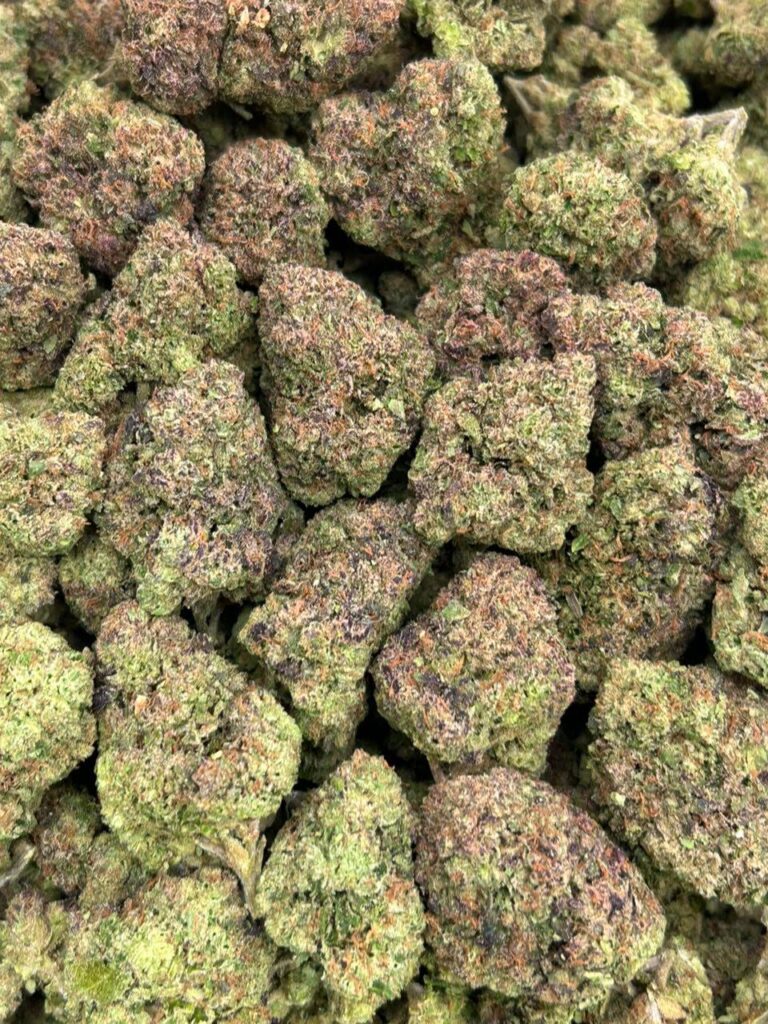
Look at the color and structure. Good Candy Gas usually shows dense, sticky buds with a mix of deep green or purple tones, orange or amber hairs, and a heavy, frosty coating of trichomes (the little crystal-looking hairs that hold most of the THC and terpenes). If the buds look dry, loose, or fall apart when you gently squeeze them, that’s a sign of a lower quality cure, even if the strain name is right.
Trust your nose. Fresh, well cured Candy Gas should smell strong the moment the container opens, with a clear sweet note up front and gas underneath. If all you smell is a faint, generic weed smell, the terpenes have likely faded from age or bad storage, and the effects probably will feel weaker too, regardless of what the label’s THC number says.
Ask about the lab results. A legit dispensary or hemp retailer should be able to show you a Certificate of Analysis, sometimes called a COA. This tells you the actual tested THC, THCA, and terpene percentages for that specific batch, not just a general range someone wrote on a menu.
Don’t judge purely on THC number. As I mentioned earlier, a jar with slightly lower THC but a high terpene total (over 2.5%) can genuinely feel stronger and taste better than a jar with a bigger THC number and almost no smell. If you can smell two jars side by side, let your nose help make the call.
What Does Candy Gas Cost? 💵
Pricing lands in the upper-mid to premium tier compared to average strains, and that tracks with the demand for its flavor and its trichome-heavy, photogenic bag appeal.
Realistic ranges vary a lot by region and by whether you’re buying top-shelf indoor flower or a budget batch, but a few real data points are worth knowing. Older Leafly pricing data for the Crockett Family Farms version listed it around $10 to $15 per gram. More recent reports, including Herb’s 2026 pricing rundown, point to a Reddit user paying roughly $60 for a 7 gram bag before a discount, which works out to a bit under $9 a gram for that particular batch.
The general rule holds true here just like with most strains: top-shelf indoor flower costs more because it takes more effort, better genetics, and tighter environmental control to grow well, and it sells partly on looks and smell alone. Budget or bulk versions of Candy Gas exist too, and they can be perfectly smokable, but they tend to be less vivid in color and quieter in smell. If you’re a beginner on a budget, there’s nothing wrong with starting with a budget batch. Just adjust your expectations on how loud the candy and gas notes will actually be.
Growing Candy Gas at Home 🌱
I get this question a lot, so let’s cover it briefly, even though most beginners reading this are here to smoke it, not grow it.
Candy Gas is considered a moderate-to-advanced grow. It’s not the easiest strain to start with if you’ve never grown cannabis before, mainly because it tests you on environmental control and feeding precision to bring out its full flavor and potency.
A few specifics worth knowing if you’re curious or already growing: it thrives in warm, dry, Mediterranean-style conditions, and indoor growing is strongly recommended to protect the terpenes and prevent mold from forming in those dense, tightly packed buds. Expect a moderate stretch during the switch to flowering, roughly 1.5 to 2 times the plant’s pre-flower height, and it responds well to topping and low-stress training if you want to build a flat, even canopy for better light coverage.
Flowering time runs about 8 to 9 weeks, or roughly 58 to 63 days depending on the specific breeder line, according to seed retailer listings for the Grounded Genetics version. Cooler nights toward the end of flowering tend to bring out better color and terpene expression in the final buds.
Yield is generally described as medium to high, which is solid for a flavor-focused strain, though as always, actual results depend heavily on your setup, lighting, and experience level.
If you’re brand new to growing, I’d honestly suggest starting with an easier, more forgiving strain first and coming back to Candy Gas once you’ve got a full grow cycle or two under your belt. It rewards experience.
A Quick Legal Note for 2026 🧾
I want to include this because it’s genuinely changing right now, and it affects a lot of people buying Candy Gas as hemp-derived THCA flower rather than through a state licensed dispensary.
For years, THCA flower (including a lot of Candy Gas sold online and in smoke shops) existed in a legal gray area created by the 2018 Farm Bill. That law only restricted delta-9 THC specifically, and said nothing about THCA, the non-intoxicating precursor that converts into THC when you heat it. That gap let high-THCA hemp flower be sold nationwide, even in states without legal recreational cannabis, as long as it tested under 0.3% delta-9 THC.
That gap is closing. In November 2025, a new federal law (H.R. 5371, sometimes called the Continuing Appropriations Act of 2026) was signed, and it rewrites the definition of hemp to count total THC, including THCA, delta-8, and other isomers, toward that same 0.3% limit. Herb’s coverage of this change lays out the timeline clearly: enforcement kicks in on November 12, 2026, which effectively reclassifies most THCA flower, including high-potency Candy Gas sold as hemp, under federal marijuana law rather than hemp law.
Here’s what that actually means for you. State-legal, licensed cannabis dispensaries are not affected by this change at all. If you’re buying Candy Gas through a licensed recreational or medical dispensary in a legal state, nothing changes for you. If you’ve been buying THCA flower online or at a smoke shop because you’re in a state without legal recreational cannabis, that access is expected to shrink significantly once enforcement begins, and some states have already moved faster on their own. Texas, for example, banned retail sale of THCA flower specifically as of March 31, 2026, according to TribeTokes’ state-by-state guide, well ahead of the federal deadline.
My honest suggestion: check your specific state’s current rules before you buy, since this is moving fast and unevenly across the country, and don’t assume something that was legal to buy online six months ago is still legal today. This isn’t legal advice, just a heads up to look before you buy.
My Honest Take on Candy Gas 💭
After going through everything, real reviews, breeder pages, lab data, grower guides, here’s where I actually land on this strain.
Candy Gas earns its reputation. The flavor is genuinely one of the more distinctive combinations in cannabis right now, and it’s not hype, it’s a real, describable contrast between sweet candy and sharp fuel that most people notice the second the jar opens. The high is functional and enjoyable when dosed right, moving from clear-headed euphoria into comfortable body relaxation without necessarily knocking you flat, which is exactly the kind of balance a lot of people are chasing.
But it is not a gentle strain, and I don’t think it’s fair to market it as one. The THC numbers are genuinely high, the terpene content is often strong enough to intensify the experience beyond what the THC number alone suggests, and the smooth, sweet taste makes it dangerously easy to overdo before you realize it.
So here’s my actual recommendation. If you’re a total beginner, start with something weaker first, then come back to Candy Gas once you know your tolerance. If you already have some experience and you’re just new to strains at this potency, Candy Gas is a great one to try, as long as you follow the one-puff, wait-fifteen-minutes rule religiously the first time. And if you’re buying it as hemp-derived THCA flower, double check your state’s current laws before you order, because that landscape is shifting fast this year.
Respect the potency, enjoy the flavor, and don’t rush it. That’s really the whole guide in one sentence. 🍬⛽
Candy Gas Strain FAQ ❓
Is Candy Gas a good strain for someone who’s never smoked before?
Not as a very first strain. It’s genuinely high in THC, usually 20% or higher, so it can overwhelm someone with zero tolerance. It’s a great second or third strain once you know how your body handles THC.
What does Candy Gas taste like?
Sweet and fruity on the inhale, often compared to grape candy, sour apple candy, or Jolly Ranchers, followed by a sharp diesel or gas note on the exhale. The exact balance depends on the specific batch and breeder.
How much THC does Candy Gas usually have?
Most tested batches fall between 20% and 28%, with some phenotypes reported as high as 29%. Always check the lab results or Certificate of Analysis for the exact batch you’re buying, since it varies a lot.
Is Candy Gas indica or sativa?
It’s a hybrid. Some versions test as an even 50/50 split, while others, especially Gelato and Runtz based crosses, lean more indica. Most users describe an energetic, euphoric start that settles into body relaxation, without heavy couch lock, at moderate doses.
How long does the Candy Gas high last?
Around 2 to 3 hours for a moderate dose. Bigger doses tend to stretch the effects out longer and lean harder into sedation toward the end.
