 Skip to content

Cannabis strain guide · Updated for 2026 · 21+ only where legal
So you saw a jar labeled Candy Gas at the dispensary, and the sticker made your eyebrows go up. 🤨 Maybe it said 22%. Maybe the shop across town had the same strain name at 30%. That’s not a typo, and you didn’t misread it. The candy gas thc percentage printed on a label depends on a lot more than most shoppers realize, and once you know why, you’ll shop smarter every time you walk into a dispensary.
This guide breaks down what Candy Gas actually is (there’s a genetics mix-up you should know about), what its real THC range looks like across the market, why lab numbers bounce around so much, and what the high actually feels like based on real grower notes and customer reviews. No hype, no “this will change your life” nonsense. Just the facts, laid out the way a friend who’s tried a lot of weed would explain it to you. 🌿
And before you skip ahead to the number, here’s why it’s worth reading the whole thing first. THC percentage gets treated like a grade on a report card, as if a 28% jar is automatically “better” than a 22% one. That’s not how it works, and Candy Gas is honestly a great example of why. Two jars can carry the exact same strain name and still deliver a completely different experience, because the number on the sticker is only one piece of a much bigger puzzle that includes genetics, growing conditions, curing, terpene content, and (unfortunately) how honest the testing lab was. By the end of this guide, you’ll know how to read past the sticker and actually judge a jar of Candy Gas the way an experienced shopper does. 🧠
THC Range
20% – 30%+
Type
Hybrid (varies by cut)
Total Terpenes
1.5% – 4.0%
Common Genetics
Gelato 41 x Runtz
What Is Candy Gas Strain? 🌿
Here’s the part almost nobody tells you upfront: there isn’t just one Candy Gas. There are two different strains floating around under nearly the same name, and shoppers mix them up constantly.
The first one, usually called Gas Candy (sometimes flipped to Candy Gas), comes from Crockett Family Farms. Leafly lists its genetics as a cross between Kandy Kush and OG #18, and puts it right at 20% THC. It’s classified as a 50/50 hybrid, so it doesn’t lean hard in either direction. This version has been around for a while and has a solid track record on strain databases, with dozens of logged reviews.
The second one, bred by Grounded Genetics and simply called Candy Gas, is a cross of Gelato 41 and Runtz. This is the newer, flashier version that’s been showing up on dispensary menus and seed banks over the past couple of years. It’s the one most connected to those higher, 26-30%+ THC numbers you’ll see floating around online.
Why does this matter for you? Because if you buy “Candy Gas” from two different brands, you might genuinely be smoking two different plants that just happen to share a candy-and-fuel flavor theme. Always check the breeder or brand tag on your jar, not just the strain name. If your dispensary can tell you which genetic line your batch comes from, that’s a good sign they’re paying attention to the details, and it means their THC number is more likely to be trustworthy too.
Both versions share the same basic personality though. They’re built from dessert-leaning genetics (Gelato, Kandy Kush) crossed with something gassier and more fuel-forward (Runtz, OG #18). That’s where the name comes from: sweet up front, diesel on the back end. It’s a flavor style that’s dominated dispensary shelves for a few years now, and Candy Gas is one of the strains riding that wave the hardest.
Why “Candy Gas” Became A Whole Category, Not Just One Strain 🍬⛽
If you’ve noticed a bunch of strains lately with names like Candy Runtz, Gas Runtz, or plain old Candy Gas, you’re not imagining a pattern. This whole flavor family traces back to Gelato and Runtz, two closely related strain lines that both descend from Girl Scout Cookies genetics. Gelato built the template: creamy, dessert-like, balanced. Runtz pushed that same base further toward pure candy sweetness and loud, colorful bag appeal. Once breeders realized how well that sweet-and-gassy combo sold, “candy gas” stopped being one strain’s nickname and turned into a whole style that dozens of breeders now chase.
That matters for you as a shopper because it explains why the name shows up on so many different jars with so many different genetics behind it. It’s less like ordering a specific dish and more like ordering “barbecue.” You’ll get the general flavor category, but the exact recipe changes depending on who’s cooking. That’s not a knock on the strain. It just means the candy gas strain name tells you more about the flavor profile you’re about to get than it tells you about the exact plant or the exact THC number.
Candy Gas THC Percentage: The Real Range 📊
Let’s get to the number you actually came here for. Depending on which source you check, the candy gas strain THC level lands somewhere between 20% and 34%. That’s a wide window, so here’s how it breaks down across the sources that actually publish testing data or lab-backed numbers.
| Source | Reported THC / THCa | Notes |
|---|---|---|
| Leafly (Gas Candy, Crockett Family Farms) | 20% | Kandy Kush x OG #18 lineage |
| GrowDiaries | 20% | Matches Leafly’s number |
| SeedsHereNow strain review | 20% – 26% | Gelato 41 x Runtz lineage |
| JointCommerce strain guide | Mid-20s%, up to 22-29% | Notes 26-34% total cannabinoids on some COAs |
| Candy Gas Strain Clinic | 24% – 30%+ | Describes routine testing above 24% |
| THCa flower brand (Green Unicorn Farms) | 21.73% THCa | Hemp-derived THCa flower listing |
| THCa flower brand (Ounce of Hope) | 30.8% THCa | Tennessee hemp-market listing |
If you average out the middle of the road here, most credible sources put Candy Gas somewhere in the low-to-mid 20% range, with premium or boutique batches pushing into the high 20s and occasionally the low 30s on THCa flower specifically. That 20-26% window is the one to treat as your realistic baseline. Anything advertised north of 30% deserves a second look at the actual lab certificate, not just the shelf tag. We’ll get into exactly why in the next section, because it matters more than most shoppers think. 👇
THC Creep: Why Percentages Keep Climbing Every Year 📈
Here’s some context that makes the candy gas thc percentage conversation make a lot more sense. Go back to the early 2010s, and 15-18% THC flower was considered strong. A strain testing at 20% was treated as top-shelf, almost boastful. Fast forward to today, and 20% is basically the entry point for a “premium” strain like Candy Gas, with plenty of jars pushing past 25% and some claiming 30%+.
Some of that increase is real and comes from actual breeding progress. Decades of selective breeding, better indoor growing technology, and more precise nutrient and light control have genuinely pushed plants to produce more cannabinoids than older genetics could manage. Growers also learned to select cuts specifically for higher resin and trichome density, which does raise real THC output.
But a good chunk of that climb also comes from market pressure, not plant biology. Once shoppers started treating THC percentage as a stand-in for quality, brands had every incentive to chase bigger numbers, and as covered in the section below, some labs were happy to help them get there on paper even when the plant itself hadn’t changed. That’s part of why comparing a “20% strain” from 2015 to a “20% strain” today isn’t always an apples-to-apples comparison, and why a modern Candy Gas jar reading 22-24% can still deliver a genuinely strong, well-rounded high even though it looks modest next to flashier numbers on the shelf next to it.
Why Two Jars Of Candy Gas Can Have Wildly Different Numbers 🚩
Here’s the honest, slightly uncomfortable truth about cannabis potency numbers in 2026: the candy gas thc percentage on a label isn’t always what actually came out of the plant. There are two separate things going on, and it helps to understand both.
1. Plants are living things, and phenotypes vary
Even within the same strain name and the same genetic cross, individual plants (called phenotypes, or “phenos” for short) can test differently. Growing conditions matter too. Light intensity, nutrient timing, humidity control during flowering, and when exactly the grower harvests all shift the final cannabinoid count. A top-shelf indoor grower running a tight environment might genuinely pull 26-28% THC from a Candy Gas cut. A budget outdoor grow of the same genetics might land closer to 16-18%. That part is normal, and it’s just how agriculture works. Tomatoes from your backyard don’t taste identical to store-bought ones either. 🍅
2. Lab shopping and THC inflation are a real, documented problem
This is the part that doesn’t get talked about enough. An investigation covered by MJBizDaily found that THC potency on legal-market flower is routinely inflated, in some cases by 25% or more above the true lab result. Industry lab operators quoted in the piece didn’t call it a rounding error. They called it fraud, plain and simple.
The mechanism is called “lab shopping.” A grower sends the same batch of flower to multiple testing labs. Some labs report accurate numbers. Others, facing pressure to keep clients happy (and keep their business), report inflated ones. The grower picks whichever lab gave them the biggest number, slaps that on the label, and sells the flower at a premium, because shoppers pay more for a 28% jar than a 19% jar, even when the two are chemically almost identical. A 2026 industry study found that roughly half of licensed products deviated by more than 20% from their labeled THC concentration. That’s not a small gap. That’s basically a coin flip on whether your label is honest. 😬
There’s a regulatory shift happening too. Starting November 12, 2026, federal rules require hemp and cannabis products to be labeled by Total THC instead of letting brands report just THCa (the non-active acid form that converts to real THC when you heat it). This closes a loophole that let some hemp-market flower advertise sky-high THCa numbers that didn’t reflect what you’d actually feel after combustion. If you’re shopping THCa flower specifically (common in states without adult-use dispensaries), keep an eye out for updated labels after that date. The number you see should get more honest, not less.
What does this mean for you as a Candy Gas shopper? Don’t chase the highest number on the shelf. A 30% jar from a lab known for friendly results can feel weaker than a properly tested 22% jar with a rich terpene profile. Buy from brands that post their full certificate of analysis (COA), not just a headline percentage, and pay attention to the total terpene number too. That leads us to the next part, because terpenes might matter more than the THC number does. 🧪
One more thing: THC and THCa are not the same number
This trips up a lot of shoppers, especially anyone buying hemp-derived Candy Gas THCa flower. Raw cannabis flower doesn’t actually contain much active THC. Instead, it’s loaded with THCa, an acidic form that only converts into real, psychoactive THC once you apply heat, like when you smoke or vaporize it. That conversion process is called decarboxylation.
Here’s the math labs use: multiply the THCa percentage by roughly 0.877 to estimate the actual THC you’ll get after heating it. So a jar listing 30.8% THCa (like the Ounce of Hope listing mentioned above) actually converts to somewhere around 27% real THC once it’s smoked, not the full 30.8%. That’s still a strong number, but it’s an important gap to understand, especially since a lot of hemp-market Candy Gas is sold specifically as THCa flower rather than traditional dispensary cannabis. Some brands report “Total THC” already calculated for you, which is the more useful number to look for.
To walk through it with real numbers: the Green Unicorn Farms Candy Gas listing mentioned earlier reports 21.73% THCa. Multiply that by 0.877, and you land at roughly 19.1% Total THC after decarboxylation. That’s a meaningful difference from the number on the front of the label, and it’s exactly the kind of gap the new Total THC labeling rule is meant to close for good.
How To Read A Candy Gas Label Like A Pro 🔍
Next time you’re standing at the counter or scrolling a product page, here’s what actually matters on that label, in order of importance.
- Total THC (not just THCa): This is the number that reflects what you’ll actually feel after heating the product. If a label only lists THCa, do the 0.877 math yourself, or ask the budtender.
- Total terpenes: Anything above 2% is a solid sign of a flavorful, well-cured batch. Below 1% often means dry, harsh, or old flower, no matter what the THC number says.
- Batch or lot number and test date: A recent test date (within the last few months) is more trustworthy than an old one, since cannabinoids degrade over time.
- The testing lab’s name: If you can, look up whether that lab is ISO/IEC 17025 accredited. That’s the industry gold standard for legitimate, standardized testing.
- Full cannabinoid breakdown: A label that only shows THC and nothing else (no CBD, no minor cannabinoids, no terpenes) is giving you the least information possible on purpose.
Terpenes: The Part Of The Label Most People Skip 🧪
THC percentage gets all the attention, but terpenes are doing a lot of the actual work in how a strain feels and tastes. Terpenes are the aromatic oils in the plant, the same class of compounds that give lemons their citrus smell and pine trees their pine smell. In Candy Gas, a handful of terpenes show up again and again in lab reports.
Limonene (candy-citrus top note)0.2% – 0.7%
Myrcene (earthy, herbal base)Trace – 0.5%
Caryophyllene (spicy, gassy backbone)Trace – 0.6%
Linalool (floral softness)Trace amounts
Total terpene content in decent Candy Gas usually sits between 1.5% and 3.5% by dry weight, and standout craft batches can clear 4%. As a rule of thumb, the louder the smell hits you when you crack the jar, the higher that terpene number probably is. A strain with 26% THC and 3.5% terpenes will usually feel fuller and more complex than one with 30% THC and barely 1% terpenes. This is exactly the point cannabis competition judges have made for years: THC percentage alone doesn’t predict how strong or how good an experience will be. Terpenes shape the ride just as much, maybe more.
One expert quoted in a 2026 industry roundup put it simply: the safest way to shop in today’s market is to stop staring at the THC number and start checking total cannabinoids and terpenes together. A 20% flower with 3% terpenes is going to beat a 30% flower with no aroma almost every time. Keep that in your back pocket next time you’re standing at the counter. 🛒
It also helps to know what each terpene is actually doing, not just what it smells like. Limonene is linked to that quick mood lift and social, talkative feeling a lot of reviewers describe in the first few minutes. Myrcene tends to add a heavier, more sedating quality, which is part of why a Candy Gas cut with a higher myrcene reading can feel more couch-locked than one where limonene dominates. Caryophyllene is unique among terpenes because it actually binds to cannabinoid receptors in your body, similar to a mild cannabinoid itself, and it’s associated with the anti-inflammatory, pain-easing effects several reviewers mentioned. Linalool rounds things out with a calming, almost floral softness that keeps the whole high from feeling too sharp or jittery. Together, that combination explains the fast-up, slow-down rhythm that shows up again and again in Candy Gas reviews.
What Candy Gas Actually Feels Like 😌
Numbers on a label only tell part of the story. Here’s what real growers and smokers report once they actually light it up.
The onset is usually fast, kicking in within two to five minutes of inhaling. It starts with a cerebral lift: a wave of mood elevation and mental clarity that feels social and a little energizing, not foggy. That’s the sativa-leaning side of the hybrid showing up first. After 15 to 30 minutes, the Gelato and OG-adjacent genetics take over, and a warm body relaxation spreads in. At a moderate dose, you stay functional and clear-headed. Push past that, and the indica side pulls you toward the couch and eventually toward sedation. Most reviewers report a total experience lasting two to three hours before it fades out gently.
Breaking that down into stages helps set expectations. In the first 5 to 15 minutes, expect a bright, social head change, the kind that makes conversation flow easier and puts a smile on your face without much sedation. From roughly 15 to 45 minutes, the body relaxation phase kicks in, tension easing out of your shoulders and neck while your mind stays reasonably clear at a moderate dose. From 45 minutes to about 2 hours, you’re in the peak zone, where a higher dose really does start pulling toward sedation and, for some users, mild couch-lock. After that, the fade is gradual rather than abrupt, so you’re not likely to feel like the high just shuts off.
⭐⭐⭐⭐⭐
A Reddit user in r/CanadianCannabisLPs reviewed a Plush-bred cut (built on Kandy Kush x OG Kush genetics) and called it some of the smoothest smoke they’d had in a long time, joking that they got so relaxed they thanked their phone’s autocorrect for helping finish the review.
Reddit r/CanadianCannabisLPs, cited via Herb.co roundup
⭐⭐⭐⭐
Another Leafly reviewer described their jar’s grape candy scent as unmistakable straight out of the bag, and noted the smoke stayed smooth even though the diesel note came through strong on the exhale.
Leafly customer review, Gas Candy strain page
⭐⭐⭐⭐
“Effects came on quick with a solid head change at first, then melted into a relaxed body high without completely knocking me out. Good balance between euphoric and chill,” one Leafly reviewer wrote about their jar.
Leafly customer review, Gas Candy strain page
⭐⭐⭐⭐
Another Leafly reviewer, running a half-ounce from the brand 7 Wonders, tested it at 19.17% THC and said two to three bong rips was enough to reach a comfortable, happy state without harshness on the throat.
Leafly customer review, Gas Candy strain page
⭐⭐⭐⭐
A grower’s diary shared on Reddit’s r/macrogrowery described purple-leaning Candy Gas colas as gassy and candy-sweet enough that the smell alone sold customers before they even tasted it.
Reddit r/macrogrowery, cited via Herb.co roundup
⭐⭐⭐
Not every batch nails the sweetness, though. One Reddit reviewer in r/THCaFlower rated a specific cut 7.5 out of 10, praising the loud, skunky-gas nose but noting the candy side barely showed up, and the buds crumbled more than expected when squeezed.
Reddit r/THCaFlower, cited via Herb.co roundup
One more thing worth mentioning: several reviewers connected Candy Gas to real relief, not just recreational fun. One Leafly user smoked it with a friend managing a pinched nerve and said it noticeably helped with the pain, something they linked to the terpene ocimene, which shows up in some Candy Gas phenotypes and carries a grape-like scent.
Candy Gas Strain Flavor And Aroma 🍭⛽
The name says it all, but here’s the breakdown. Cracking a jar of Candy Gas hits you with sweet, fruity candy first, sometimes described as grape or sour apple depending on the cut. Right behind that sweetness comes a sharp, skunky diesel note that lingers on the exhale. It’s a strong, loud smell either way. This isn’t a strain you can smoke quietly in a hotel bathroom with the fan on. 😅
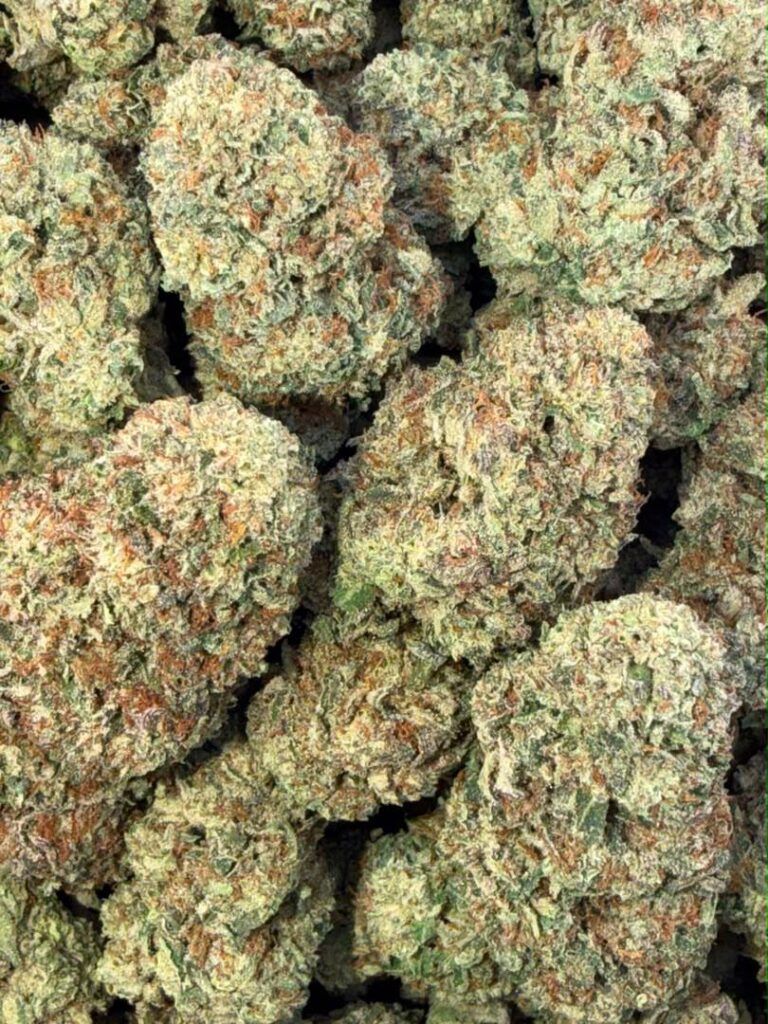
Visually, the buds tend to be dense and resin-coated, ranging from lime green to deep forest green, often streaked with purple or eggplant coloring when the plant finishes in cooler night temperatures. Bright orange pistils run through the buds, and a heavy coat of trichomes gives the whole thing a frosted, almost sugar-dusted look, which honestly fits the candy theme pretty perfectly.
What Should You Expect To Pay? 💵
Pricing on Candy Gas sits in the mid-to-premium tier, and the THC percentage on the label is only part of why. Leafly lists the average price for Gas Candy (the Kandy Kush x OG #18 version) at around $10-$15 per gram, which is fairly standard for a well-known hybrid. The flashier Gelato 41 x Runtz version tends to run a bit higher, especially from boutique or craft-focused brands leaning into the frosty bag appeal and loud aroma.
One Reddit reviewer mentioned paying close to $60 for a 7-gram bag before a discount, which lines up with premium indoor pricing rather than budget shelf pricing. As a general rule, top-shelf indoor Candy Gas costs more because it’s harder to grow well (that dense, resin-heavy structure needs tight humidity control) and it sells itself on looks and smell alone. Budget or bulk versions run cheaper but usually show less color, less frost, and a quieter smell. If a “premium” jar is priced like the budget stuff, that’s worth a second look at the actual bud before you buy.
Common Mistakes Shoppers Make With The Candy Gas THC Percentage ❌
After going through dozens of listings, reviews, and lab notes for this guide, a few patterns kept showing up. Here are the mistakes worth avoiding.
- Assuming the highest number is the best jar. A 30% jar tested at a lab known for friendly results can genuinely feel weaker than a properly tested 22% jar with a strong terpene profile. The number alone doesn’t settle the argument.
- Confusing THCa with THC. If you’re shopping hemp-derived flower and the label only shows THCa, remember that number shrinks by about 12% once it converts to real THC after heating.
- Ignoring the genetics. Since “Candy Gas” covers at least two different genetic lineages, buying based on the name alone means you might get a completely different plant than the one you tried last time.
- Skipping the terpene number. A jar with a big THC number and almost no listed terpenes is often dry, old, or poorly cured, regardless of what the front label promises.
- Judging potency by smell alone at first, then not checking the actual COA. Your nose is a good first filter, but pair it with the real lab certificate whenever a dispensary can provide one.
- Dosing based on the label instead of your own tolerance. Two people can smoke the exact same 24% jar and have completely different experiences. Dose based on how you feel, not just what the sticker says.
Pros And Cons Of Candy Gas ⚖️
👍 Pros
- Strong, well-rounded high that balances head and body effects
- Memorable, loud flavor that stands out on any menu
- Fast onset, so you’re not waiting around to feel it
- Reported help with stress, mild pain, and low mood
- Frosty, photogenic buds with real bag appeal
👎 Cons
- THC numbers vary a lot between brands, so labels aren’t always reliable
- Can cause dry mouth, dry eyes, and dizziness at higher doses
- Higher doses may trigger anxiety or mild paranoia in sensitive users
- Two different genetic lineages share the same name, which causes confusion
- Premium pricing due to demand and strong bag appeal
How To Handle The Candy Gas THC Percentage: A Simple Dosing Guide 🎯
Whether your jar says 20% or 29%, the smartest approach is the same. Here’s a simple way to pace yourself so you actually enjoy the high instead of fighting it.
- Start small. New or low-tolerance users should aim for roughly 2-5 mg of inhaled THC equivalent per session, which usually means a single small puff.
- Wait it out. Give it 10-15 minutes before taking more. Candy Gas hits fast, so you don’t need to rush a second hit to “feel something.”
- Know your ceiling. Experienced users often find their comfort zone around 10-20 mg of inhaled THC per sitting, which for a strain in the 20-26% range usually lands somewhere between two and four solid bong rips or several joint puffs.
- Match the method to the moment. Vaporizing tends to bring out more flavor with less harshness on your throat than a straight combustion hit.
- Stay hydrated. Dry mouth and dry eyes are common with high-THC strains like this one, so keep water nearby.
- Skip the alcohol. Mixing cannabis with alcohol tends to amplify sedation and dizziness rather than balance it out.
- Pick your setting. A calm, familiar space lowers the odds of anxiety showing up if you happen to take too much.
- Check the COA, not just the shelf tag. If a dispensary can show you the actual lab certificate, you’re getting a far more honest picture of the candy gas thc percentage you’re really buying.
One more note if you ever come across a Candy Gas-infused edible instead of flower or a cart: inhaled and ingested THC behave very differently in your body. Inhaled effects show up in minutes and fade in a couple of hours, but edibles can take 30 minutes to 2 hours to kick in and last 4 to 8 hours once they do. A lot of people make the mistake of eating more because “nothing’s happening yet,” only to get hit hard an hour later. If you’re trying a Candy Gas edible, start with 2.5-5 mg, wait at least 2 full hours, and resist the urge to double up early.
Candy Gas Vs Other Candy-And-Gas Strains 🥊
Candy Gas didn’t appear out of nowhere. It’s part of a whole family of dessert-meets-fuel hybrids that share genetics and a similar flavor identity. Here’s how it stacks up against its closest relatives.
| Strain | Typical THC | Genetics | Flavor Lean |
|---|---|---|---|
| Candy Gas | 20% – 29% | Gelato 41 x Runtz (or Kandy Kush x OG #18) | Sweet candy first, diesel finish |
| Candy Runtz | Low-to-mid 20s% | Zkittlez x Gelato | Fruity candy, creamy finish |
| Gelato 41 | Low-to-mid 20s% | Thin Mint GSC x Sunset Sherbet | Creamy, dessert-forward, mild gas |
| Runtz (original) | Mid-to-high 20s% | Zkittlez x Gelato | Tropical candy, colorful bag appeal |
The short version: if you like Candy Gas, Candy Runtz gives you a softer, creamier version with less diesel punch. Gelato 41 dials the gas back even further in favor of dessert notes. And original Runtz leans hardest into pure candy sweetness with less of the fuel-forward backend that defines Candy Gas specifically.
If you’re deciding between them at a dispensary counter, think about what you actually want out of the session. Want something loud and gassy that still has a sweet edge? Stick with Candy Gas. Want the sweetness turned all the way up with almost none of the fuel funk? Grab Candy Runtz or original Runtz instead. Want a smoother, creamier experience that’s a little easier on new noses? Gelato 41 is the gentler entry point into this entire flavor family. None of these choices are wrong, since they all share the same genetic roots. It really just comes down to how much “gas” you personally want in your candy. 🍬💨
Growing Candy Gas: A Quick Look For The Curious 🌱
If you’re a home grower wondering whether to add Candy Gas to your next run, here’s the short version. It’s considered a moderate-to-advanced grow, not ideal for a total beginner. The dense, resin-heavy bud structure looks great but is prone to mold if your humidity control slips during flowering, so you’ll want a dialed-in tent or greenhouse setup.
Flowering time generally runs 9 to 10 weeks, in line with its Runtz-family relatives. Cooler night temperatures in the final weeks help bring out that purple coloring in the buds, which also tends to boost bag appeal if you’re growing to sell or trade. Feed reasonably, ease off heavy nitrogen once flowering starts, and most growers recommend harvesting around 10-20% amber trichomes if you want a fuller, more body-heavy effect rather than a purely energetic one.
A few extra tips that show up consistently across grower diaries: train early with low-stress training or topping to open up the canopy, since Candy Gas tends to bush out and can shade its own lower buds if left untrained. Keep humidity strictly controlled during the last few weeks of flowering, because those dense, sugary colas are exactly the kind of bud structure that mold loves to hide inside. And go slow with nitrogen once you hit week 4 of flowering, shifting toward a bloom-focused feed with more phosphorus and potassium to support resin and trichome development. Growers chasing the highest possible THC percentage often extend the cure as well, since a slow cure over several weeks tends to preserve more terpenes and can nudge lab results higher than a rushed dry-and-shake job.
As for yield, expect a moderate output rather than a monster harvest. This isn’t a strain bred purely for maximum weight per plant. It’s bred for flavor, frost, and potency, which usually means growers accept a slightly smaller harvest in exchange for denser, more resin-heavy buds. Indoor setups with good light and airflow tend to reward growers with the strongest smell and the most vivid coloring, while outdoor grows can work in the right climate but usually show a milder aroma and less dramatic purple coloring than a carefully controlled indoor tent.
Candy Gas Concentrates And Carts: Does The Percentage Mean Something Different? 💨
If you’ve seen Candy Gas sold as a vape cartridge, live resin, or distillate instead of flower, the THC percentage game changes completely. Flower testing in the 20-29% range is considered high potency. But concentrates start where flower leaves off, since the extraction process strips away plant material and concentrates the cannabinoids that are left.
Here’s roughly how that breaks down by product type:
| Product Type | Typical THC Range | Notes |
|---|---|---|
| Flower | 20% – 29% | Includes all the terpenes and minor cannabinoids naturally present |
| Live resin / rosin | 60% – 80% | Preserves more original terpene flavor than distillate |
| Distillate cartridges | 80% – 90%+ | Highly refined, often has terpenes added back in after extraction |
| Solventless hash / rosin dabs | 50% – 75% | Flavor and effect can feel closer to the original flower |
A quick heads up if you’re shopping for a Candy Gas vape cartridge specifically: a lot of carts labeled with a strain name are flavored with added terpenes rather than terpenes pulled straight from that exact plant. That’s not automatically bad, since it can still taste accurate, but it does mean a “Candy Gas” cart’s flavor and a “Candy Gas” flower’s flavor may not be identical, even if both taste great. If a brand specifies “strain-specific” or “live resin” terpenes, that’s a sign they extracted the real thing rather than adding a flavor blend afterward. Whatever the format, the same rule from earlier still applies: check the actual COA rather than trusting the percentage printed on the box alone, since concentrate testing has faced its own share of lab shopping concerns too.
Medical And Wellness Angle: What Users Report 🌿
A good number of the reviews behind this guide weren’t just about getting high for fun. Plenty of people reach for Candy Gas specifically to manage something else going on in their day. Based on community reports across multiple strain databases, the most commonly mentioned uses are:
- Stress and everyday tension: The fast-onset euphoria seems to quiet racing thoughts quickly, which is probably the single most repeated benefit across reviews.
- Anxiety, in smaller doses: Limonene and linalool are both associated with calming, mood-lifting effects at moderate amounts, though the same strain at a high dose can flip and trigger anxiety in sensitive users instead.
- Mild to moderate pain: Caryophyllene’s anti-inflammatory properties come up often, and one reviewer specifically credited the strain with helping a friend manage pain from a pinched nerve.
- Sleep support at higher doses: Once the indica side takes over later in the session, several users describe it easing them toward sleep, though this is dose-dependent rather than guaranteed at lower amounts.
- Low appetite: As with many THC-forward strains, some users report an appetite boost, which can be helpful for anyone dealing with nausea or a reduced appetite from another condition.
None of this is a substitute for actual medical treatment, and cannabis affects everyone differently based on body chemistry, dose, and tolerance. If you’re using Candy Gas (or any cannabis product) to manage a specific health condition, loop in a doctor who knows your full medical picture, especially if you’re taking other medications.
Why Candy Gas Is Trending Right Now 🔥
Part of the reason you’re seeing Candy Gas everywhere in 2026 comes down to two things buyers consistently chase: bold flavor and strong potency. Industry data on top-selling strains keeps showing average THC in the 20-25% range as the sweet spot shoppers gravitate toward, and Candy Gas sits right in that pocket while also delivering the loud, dessert-and-fuel flavor combo that’s dominated premium menus for the past few years.
There’s also a visual side to it. Dispensary menus are increasingly photo-driven, whether that’s an online menu, a delivery app, or a social media post from a brand. Candy Gas photographs well: dense, frosty, colorful buds with a mix of purple, green, and orange that stands out in a grid of product photos. Growers on forums like r/macrogrowery have flat-out said their purple-leaning Candy Gas colas practically sell themselves on looks and smell before a customer even asks about the THC percentage. In a crowded market full of strains chasing the same “candy gas” flavor identity, that combination of nose, look, and reliable potency is exactly what keeps this one near the top of dispensary menus.
Who Should (And Shouldn’t) Reach For Candy Gas 🙋
Candy Gas is generally recommended for people who already have some experience with cannabis. Because THC can realistically land anywhere from 20% to near 30% depending on the batch, it’s not the gentlest starting point if you’ve never used cannabis before.
That said, it can still work for a first-timer if you’re careful with dosing (see the steps above) and you’re consuming in a legal state or region with proper lab testing. People managing everyday stress, mild pain, or low mood have reported real benefit from this strain, largely thanks to the limonene and caryophyllene in its terpene profile.
On the flip side, if you’re prone to anxiety or panic with cannabis, or you’re sensitive to high-THC strains in general, this probably isn’t the best pick, at least not without going very slow and sticking to a small dose. And if you’re pregnant, nursing, managing a heart condition, or taking medication that interacts with cannabis, talk to your doctor before trying it. This article is educational, not medical advice. 🩺
One more note for regular consumers: if you find yourself needing more and more Candy Gas to feel the same effect, that’s your tolerance building, not the strain getting weaker. A short tolerance break, even just a few days to a week, resets your system more effectively than chasing a higher THC percentage ever will. It’s also a lot easier on your wallet, since you’ll need less product to get back to that sweet spot.
Timing matters too. Because the head high comes on fast and clear, a lot of reviewers reach for Candy Gas in the afternoon or early evening rather than first thing in the morning, especially if they still have things to get done that day. Save the higher doses, the ones that lean into the sedating side of the strain, for evenings when you don’t need to drive, operate anything, or stay sharp for work. Reviewers consistently describe it as a solid pick for winding down after a long day, less so as a wake-and-bake strain for people who need to function immediately afterward.
A Quick Word On Legal And Responsible Use ⚠️
Heads up: Cannabis laws vary by state, country, and region. Only purchase and use Candy Gas or any cannabis product where it’s legal to do so, and only if you meet the local legal age requirement (typically 21+ in adult-use markets). Buy from licensed, lab-tested sources whenever possible, and check the full certificate of analysis rather than relying on the headline THC number alone. Never drive or operate machinery after using cannabis. Keep all cannabis products away from children and pets. This article is for general educational purposes and isn’t medical advice. Talk to a healthcare provider if you have questions about cannabis and your specific health situation.
Quick Recap Before You Go 📝
Realistic THC Range
20% – 26%
Premium/Boutique Range
26% – 30%+
THCa to THC Conversion
x 0.877
Typical High Duration
2 – 3 hours
If you only remember five things from this whole guide, make it these: Candy Gas covers two different genetic lineages sharing one name, so check the breeder tag. The realistic THC range sits mostly between 20% and 26%, with higher numbers needing a closer look. Terpenes matter just as much as THC for how strong and enjoyable the high actually feels. Lab shopping and THC inflation are real, documented problems, so a full COA beats a shelf tag every time. And no matter what the label says, start low, wait it out, and dose based on how you feel, not just what’s printed on the jar. 🍬
Candy Gas THC Percentage: Quick Answers ❓
What is the average candy gas thc percentage?
Most credible sources put it between 20% and 26%, with some premium or boutique batches testing into the high 20s and occasional THCa hemp-flower listings reaching into the low 30s.
Is Candy Gas an indica or a sativa?
It’s a hybrid. Leafly’s version lists it as an even 50/50 split. Some other listings describe it as slightly indica-leaning, around 60/40. Either way, expect a mix of head and body effects rather than one extreme or the other.
Why do different dispensaries list different THC percentages for the same strain?
Two reasons. First, natural plant variation and growing conditions genuinely change the final cannabinoid count. Second, a documented industry problem called lab shopping means some labs report inflated numbers to keep growers happy. Always check for a full lab certificate, not just the shelf tag.
What does Candy Gas taste like?
Sweet, fruity candy up front (sometimes grape or sour apple), followed by a sharp, skunky diesel note on the exhale. It’s a loud, memorable smell either way.
How long does the Candy Gas high last?
Most users report effects lasting around two to three hours, starting with a cerebral lift and easing into body relaxation as the session goes on.
Is Candy Gas good for beginners?
It can work for new users, but caution matters, since THC can run fairly high. Start with a small puff, wait 10-15 minutes, and go slow before deciding on more.
What are the genetics behind Candy Gas?
There are two lineages floating around under this name. One version (often labeled Gas Candy) comes from Kandy Kush x OG #18, bred by Crockett Family Farms. The other, more recent version comes from Gelato 41 x Runtz, bred by Grounded Genetics.
What are the most common side effects?
Dry mouth and dry eyes are the most reported. At higher doses, some users experience dizziness or mild anxiety, especially if they have a low tolerance.
Is Candy Gas THCa flower the same as regular THC flower?
Not exactly. THCa converts into active THC once it’s heated, at roughly 87.7% efficiency. A jar listing 30% THCa converts to around 26-27% actual THC after smoking or vaping, which is still strong but not quite the number printed on the label.
Why do THC percentages on labels sometimes seem too high to be real?
Because sometimes they are. Industry investigations have found that potency inflation and lab shopping are widespread, with one 2026 study finding that roughly half of tested products deviated by more than 20% from their labeled THC. Always look for a full certificate of analysis.
Does a higher THC percentage always mean a stronger high?
Not necessarily. Terpene content, minor cannabinoids, your personal tolerance, and how the flower was cured all shape the actual strength and quality of the high just as much as the THC number does.
Is Candy Gas the same as Gas Candy?
They’re closely related names for the same general strain family, but not always the identical plant. Gas Candy usually refers to the Kandy Kush x OG #18 cross from Crockett Family Farms, while Candy Gas is often used for the newer Gelato 41 x Runtz cross from Grounded Genetics. Check the breeder tag to know which one you’re actually buying.
How much does Candy Gas usually cost?
Expect somewhere around $10-$15 per gram for standard offerings, with premium indoor or boutique-grown batches running higher due to strong demand and standout bag appeal.
The Bottom Line On Candy Gas THC Percentage 🍬
The candy gas thc percentage you see on a jar is real information, but it’s not the whole picture. Genetics vary. Growing conditions vary. And unfortunately, lab testing practices vary too, sometimes in ways that aren’t honest. A strain that tests at 22% with a rich terpene profile can easily out-perform a “30%” jar from a lab known for friendly numbers.
So here’s the simple version: know which Candy Gas lineage you’re buying, check for a real lab certificate when you can, pace your dosing no matter what the label says, and pay just as much attention to the terpene percentage as you do to THC. Do that, and you’ll get a much more honest read on what you’re actually about to smoke, no matter which jar of Candy Gas ends up in your hands. 🌿✌️
None of this means you should avoid high-THC strains or panic every time you see a big number on a label. It just means you’re better off treating the candy gas thc percentage as one clue among several, not the whole verdict. Ask about the lineage. Ask to see the COA. Smell the jar before you decide, since your nose is honestly one of the better potency detectors you have. And remember that the upcoming Total THC labeling rule taking effect in November 2026 is a real step toward cleaner, more honest numbers across the whole industry, Candy Gas included. Until then, a little skepticism and a slow, steady approach to dosing will serve you a lot better than chasing the biggest percentage on the shelf. 🍬💨
One last honest note: strain data changes over time, and reviews reflect individual experiences that won’t match everyone’s. The THC ranges, terpene numbers, and effects described here come from published lab-adjacent sources, grower diaries, and customer reviews across multiple platforms, cross-checked against each other rather than taken from a single source. Treat all of it as a solid starting point for your own research, not a guaranteed outcome for your specific jar.
