 Skip to content

If you’ve ever stood in a dispensary and stared at two jars, one labeled “Candy Gas” and one labeled “OG Kush,” you’ve probably asked yourself the same question I did the first time I saw this: are these even related? 🤔
Short answer: yes, kind of. Long answer: it’s complicated, and honestly, that’s what makes it interesting.
I’ve spent a lot of time researching cannabis genetics for this site, and the “candy gas og” search term comes up a lot. People want to know if candy gas strain is just OG Kush with a sweeter name slapped on it, or if it’s something totally different that just borrows some OG DNA. So let’s actually sort this out. No fluff, no guessing. Just what the breeders, the lab data, and real growers have to say. 🌱
What Is Candy Gas, Really? 🍬
Here’s the first thing you need to know, and it trips up a lot of people. Candy Gas isn’t one single strain with one fixed genetic code. It’s actually two different things wearing the same name.
The first version comes from Crockett Family Farms. Their cut, sometimes listed as Gas Candy, is a cross between Kandy Kush and OG #18. It’s about a 50/50 hybrid, and it usually tests around 20% THC according to Leafly’s strain page.
The second version comes from Grounded Genetics, and it’s a cross of Bacio Gelato and Runtz. This is the one SeedsHereNow writes about, and it leans more into that deep purple, frosty, dessert-strain look.
So when someone says “candy gas strain,” they might be talking about either one. Weedmaps confirms this directly, noting there’s real disagreement about which lineage is the “true” one.
And here’s where it gets even wider. A lot of breeders now use “Candy Gas” as a style label, not just a strain name. Herb.co explains it well: the name gets used for any hybrid that pairs sweet, candy-like terpenes with a heavy fuel smell underneath. So you might see five different “Candy Gas” cuts from five different growers, and they won’t all taste the same or share the same parents.
This isn’t unusual in cannabis. Names travel faster than paperwork does. But it does mean you need to look past the label if you actually care about what’s in your jar.
What Does “OG” Actually Mean? ⛽
Now let’s talk about the other half of this question. What does “OG” even mean in weed terms?
People argue about this constantly. Some say it stands for “Original Gangster.” Others say it’s “Ocean Grown,” pointing to a California coastal origin story. Verts Dispensary covers both theories and honestly, nobody has fully settled it.
What we do know is where OG Kush itself came from, more or less. The most common story goes like this: a grower named Matt “Bubba” Berger found an interesting plant in a random bag of flower in Florida back in 1992. He and his partner, Josh Del Rosso (known as Josh D), brought clones out to Los Angeles in 1996 and started calling it OG Kush. DNA Genetics tells this version in detail, and it’s the story most seed banks repeat.
As for the actual genetics, most sources point to a mix of Chemdawg, Lemon Thai, and a Hindu Kush landrace. AllBud describes OG Kush as a slightly sativa-leaning hybrid built on that Chemdawg x Hindu Kush base, while ZenSeedsBank adds the Lemon Thai piece to the puzzle, saying it’s what gives OG Kush its citrusy edge on top of the fuel.
One detail I found interesting: according to breeder Josh D himself, as reported by SeaweedDelivery, the actual cross was a Chemdawg S1 (a selfed Chemdawg seed) crossed with a Lemon Thai and Pakistani Kush hybrid. That’s a bit more specific than the usual “Chemdawg x Hindu Kush” shorthand you see everywhere.
So “OG” isn’t really a strain family in the strict genetic sense. It’s more like a badge. It tells you a plant traces back, in some way, to that original 1990s Los Angeles lineage. Once OG Kush blew up, breeders started tacking “OG” onto anything with that same earthy, fuel-forward character, whether or not it actually shares real genetic material with the original plant. That’s part of why this whole topic gets confusing fast.
How OG Genetics Actually Ended Up Inside Candy Gas 🔗
Okay, so here’s the part that answers the real question behind “candy gas og.” Does Candy Gas actually contain OG genetics, or is that just marketing?
For the Crockett Family Farms version, the answer is yes, directly. One of its two parents is OG #18, which is itself an OG Kush cut. So that version of Candy Gas is, quite literally, half OG Kush by lineage. The other half, Kandy Kush, brings the sweet side of the name.
For the Grounded Genetics version (Bacio Gelato x Runtz), the OG connection is less direct but still there if you trace the family tree back far enough. Gelato strains descend from Sunset Sherbet and Thin Mint Girl Scout Cookies, and GSC itself has OG Kush as a grandparent. So even the “candy” lineage of Candy Gas has OG somewhere in its roots, just a generation or two further back.
JointCommerce breaks this down from a chemistry angle, explaining that the “gas” smell in strains like this tends to track with caryophyllene-heavy, OG-adjacent genetics, while the “candy” smell comes from limonene, linalool, and ocimene. So even when the family tree isn’t crystal clear on paper, the terpene chemistry backs up the idea that OG-style genetics are doing real work in that “gas” half of the name.
This is honestly the cleanest way to think about it. “Candy” tells you about the sweet, sugary, fruity side of the terpene profile. “Gas” tells you about the fuel, diesel, and skunk side, and that side is almost always traceable back to OG or Chem-family genetics somewhere in the plant’s history. Candy Gas OG, as a search phrase, is basically people trying to understand that exact split.
Candy Gas vs OG Kush: Terpenes Side by Side 🧪
Terpenes are the oils that give weed its smell and flavor. They also shape a good chunk of how a strain feels when you smoke it. So let’s compare.
OG Kush leans on:
- Myrcene, which brings an earthy, herbal note and adds to that heavy, sleepy feeling
- Caryophyllene, which gives it that peppery, fuel-like kick
- Limonene, in smaller amounts, adding a touch of citrus on top of the funk
Candy Gas (either lineage) leans on:
- Limonene, often the dominant terpene, giving that candy-sweet citrus front
- Caryophyllene, carrying over the gas and pepper notes from its OG-linked parent
- Linalool and ocimene, adding a floral, almost fruity sweetness that OG Kush doesn’t really have
JointCommerce notes that good Candy Gas batches usually test between 2% and 4% total terpenes, which is a strong number for flower. That’s part of why it smells so loud in the jar.
So here’s the simple version. OG Kush smells like fuel first, with a little sweetness hiding underneath. Candy Gas flips that ratio. Candy up front, fuel underneath. Same basic terpene family, different balance.
Aroma and Flavor: Candy Meets Fuel 👃
If you’ve smelled OG Kush before, you know that smell. Pine, gas station, a little bit of skunk. It’s not subtle. Crack open a jar and the whole room knows.
Candy Gas hits differently. The first thing you notice is sweet. Think fruit candy, sometimes grape or berry depending on the cut, sometimes more of a creamy dessert note if you’ve got the Gelato-Runtz version. Then a few seconds later, the fuel shows up underneath. SeedsHereNow describes this well, talking about fruity and floral scents up top with a Runtz-style candy fragrance running through the whole thing.
I think this is actually the best way to explain the “candy gas og” connection to someone who’s never smelled either one. Imagine OG Kush’s gas smell, then imagine someone poured a bag of sour candy into the jar with it. That’s roughly what you’re getting with a well-grown Candy Gas.
Flavor-wise, it tracks pretty closely with the smell. OG Kush tastes like pine and diesel on the exhale, sometimes with a slightly sour edge. Candy Gas gives you sweetness first, then a gassy aftertaste that lingers. Some people say that aftertaste is the giveaway that there’s real OG genetics working somewhere in the plant.
Effects: What You’ll Actually Feel 💭
This is probably the part people care about most, so let’s be straight about it.
OG Kush is known for a strong head-to-body wave. You get an initial lift, kind of euphoric and social, and then it settles into your body over the next 20 to 30 minutes. AllBud’s reviewers describe it as filling your head with an “unfocused happiness,” and a lot of people report getting talkative and giggly before the body relaxation kicks in. It’s a strong strain, and if you overdo it, you’ll likely end up glued to the couch.
Candy Gas is generally described as more balanced. Herb.co’s rundown puts it as a euphoric head lift that eases into warm body relaxation, without necessarily knocking you flat. It’s still potent, but the come-down feels a little smoother, probably because the sweeter terpene profile (more limonene, less pure myrcene) tends to keep things from getting too heavy too fast.
One thing worth flagging clearly: THC percentage doesn’t fully explain how a strain feels. The terpene mix matters just as much, maybe more. That’s part of why two strains with similar THC numbers can feel completely different once you actually smoke them.
THC and Potency: Which Hits Harder 🔥
Numbers time. OG Kush generally lands in the 19% to 26% THC range, according to Rare Harvest’s strain profile. Older, less refined cuts from the 90s and early 2000s tested lower, closer to 18-24%, based on historical data referenced by SeaweedDelivery. Modern selective breeding has pushed some cuts higher.
Candy Gas usually tests a bit hotter. Herb.co reports THC often lands in the mid-20s and up, and Leafly lists the Crockett Family Farms version around 20%, though that number varies a lot depending on which grower’s cut you’re buying and how it was cured.
So if raw potency is what you’re after, Candy Gas edges out classic OG Kush on paper, most of the time. But again, don’t sleep on terpenes. A well-cured 22% OG Kush can hit harder in practice than a rushed, poorly cured 28% Candy Gas. Numbers on a label only tell part of the story.
Appearance: Spotting Them In the Jar 👀
You can actually tell a lot just by looking, if you know what to check for.
OG Kush buds tend to be dense, chunky, and bright green, with a heavy coat of trichomes and bright orange pistils weaving through. Abstract’s history piece describes the classic look as sticky and pungent, with that dense structure that’s stayed consistent across most OG cuts for decades.
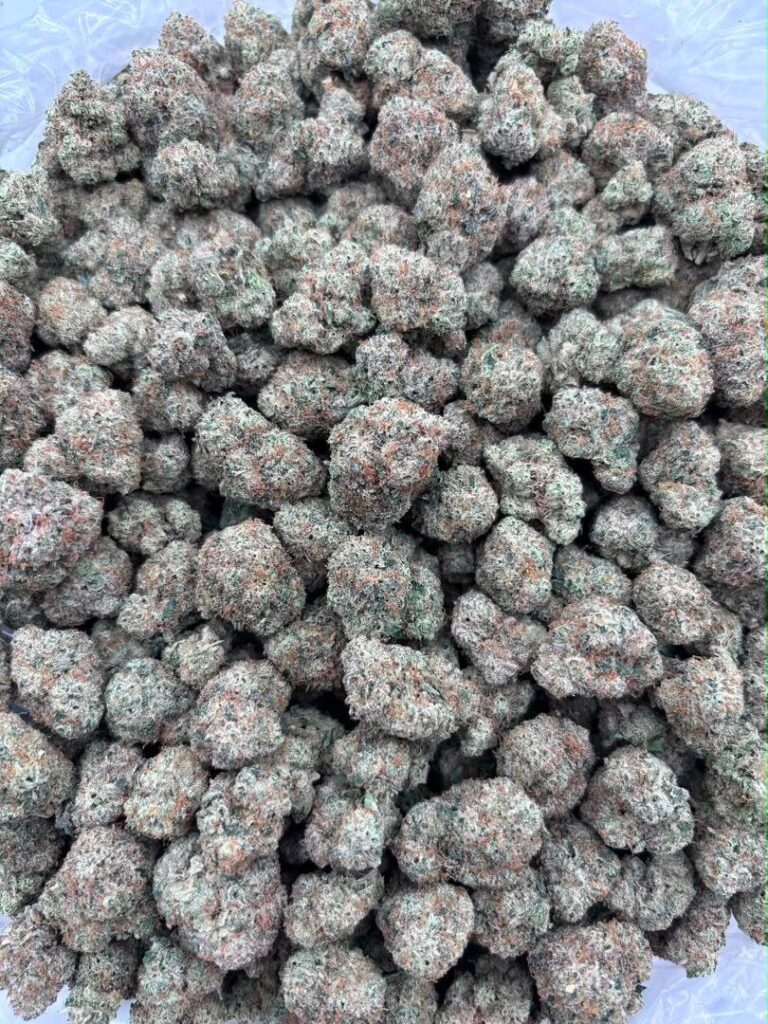
Candy Gas has a different vibe, especially the Gelato-Runtz version. Expect deep purple hues mixed with vibrant green, orange hairs, and a thick, frosty trichome layer that almost looks like it’s been dusted with sugar. SeedsHereNow calls this “fantastic bag appeal,” and honestly, that’s fair. It’s one of the better-looking strains on a shelf right now.
If you’re shopping and can only see the jar (not smell it), color is actually a decent quick clue. Heavy purple and frost usually points toward the candy/dessert lineage. More classic green and orange, with a fuel smell as soon as you open the lid, points toward the OG-heavy side.
Growing Candy Gas vs OG Kush 🌱
If you’re a home grower or just curious about why one costs more than the other, this section matters.
OG Kush has a reputation for being finicky. It’s prone to issues like root problems and can be sensitive to overfeeding, which is part of why experienced growers often treat it as a “know what you’re doing” strain rather than a beginner pick.
Candy Gas is rated moderate to advanced difficulty too, but for different reasons. Herb.co’s grow notes recommend growing it indoors for tighter control over terpenes and mold, since the dense, resin-heavy buds can trap moisture if humidity isn’t managed in late flower. It also stretches 1.5 to 2 times its size after the switch to flowering, so growers need to plan for that extra headroom. Training early, around node 4 or 5, and using low-stress training techniques helps build a fuller canopy with more even light coverage.
Veg time for Candy Gas usually runs 4 to 6 weeks before flipping to flower, and cooler nights late in the cycle are what bring out those deep purple colors. Feeding needs to be precise. Not too hot, not too light. Organic-amended soil tends to bring out the fullest flavor, based on grower reports Herb.co compiled.
Bottom line: neither of these is a “set it and forget it” strain. If you’re new to growing, there are easier options out there. If you’ve got a season or two under your belt, both are worth the effort.
What Real Users Are Saying 🗣️
I always think reviews matter more than marketing copy, so here’s what actual people are reporting across the major platforms.
For Candy Gas, Herb.co pulled together reviews from Leafly, Weedmaps, Reddit, and dispensary pages and found two things people agree on again and again: the flavor is loud, and the high is strong and balanced. People also consistently warn that the potency can sneak up on you, especially if you’re not used to strains in the mid-20% THC range. Low-tolerance smokers are told to go slow.
For OG Kush, reviewers on AllBud describe it as one of the most recognizable and reliable highs in cannabis. People mention that social, giggly window before the body relaxation sets in, and a lot of long-time users treat it as a benchmark strain. If someone’s trying to explain what a “classic hybrid high” feels like, OG Kush is usually the example they reach for.
One theme that comes up in both sets of reviews: consistency depends heavily on the specific grower and cut. Because both strains have murky or split lineages, your experience with “OG Kush” from one dispensary might not match your experience with “OG Kush” from another. Same goes double for Candy Gas, since it’s not even one settled genetic line.
Family Tree: From Landrace Kush to Candy Gas 🌳
Let’s zoom out and look at the bigger picture, because I think this actually makes everything click.
It starts with landrace strains. These are wild, naturally occurring cannabis plants from specific regions, grown the same way for generations before modern breeding got involved. Hindu Kush, from the mountains between Afghanistan and Pakistan, is one of the most important landrace strains in this story. CaliTerpenes has a solid write-up on how these landrace genetics traveled west during the hippie trail era of the 60s and 70s.
Hindu Kush eventually got crossed with Chemdawg (and, depending on the version of the story, Lemon Thai) to create OG Kush in the early 90s. OG Kush then became the parent, grandparent, or great-grandparent of a huge chunk of modern cannabis. Rare Harvest lists notable OG Kush offspring including Girl Scout Cookies, Wedding Cake, Headband, SFV OG, and Fire OG.
From there, Girl Scout Cookies helped produce Gelato strains. Gelato helped produce parts of the modern “dessert” cannabis wave, feeding into strains like Runtz. Meanwhile, other breeders kept crossing OG lines directly, which is how you get things like OG #18, one half of the Crockett Family Farms Candy Gas.
So Candy Gas isn’t some random new invention. It’s the latest branch on a tree that’s been growing since landrace Kush genetics first made their way to California decades ago. That’s honestly what makes the “candy gas og” question worth asking in the first place. You’re not comparing two unrelated things. You’re looking at two different points on the same family tree.
Price and Where to Find Them 💰
Pricing varies a lot by region and dispensary, but here’s a general sense of what to expect.
Leafly lists the Crockett Family Farms Gas Candy cut at roughly $10 to $15 per gram, which puts it solidly in the premium flower category. OG Kush pricing tends to be a bit more accessible these days simply because it’s been around so long and is widely cloned, though top-shelf, well-cured cuts still command higher prices than mid-shelf jars.
Because both of these names get used loosely by different growers, price alone won’t tell you much about quality. Your best move is always checking lab results if the dispensary provides them (most licensed ones do). Look at total terpene percentage, not just THC. A strain testing 3% terpenes is going to taste and feel more complete than one testing 1%, even if the THC numbers look similar.
Common Myths About Candy Gas OG Genetics ❌
Let’s clear up a few things people get wrong.
Myth: Candy Gas is just a nickname for OG Kush.
Not true. They’re related, sometimes closely, but Candy Gas is its own hybrid with distinct parents, not a renamed version of OG Kush.
Myth: Every Candy Gas jar has the same genetics.
Also not true. As we covered, there are at least two different named lineages, plus a whole category of strains using “Candy Gas” as a style label rather than a fixed genetic name.
Myth: “OG” always means the same genetics.
Nope. OG has become shorthand for a certain smell and feel, earthy, fuel-forward, potent, more than it’s a strict family tree. Plenty of strains carry “OG” in the name without sharing direct lineage with the original OG Kush.
Myth: Higher THC always means a stronger, better high.
This one trips up a lot of shoppers. Terpenes shape the experience just as much as THC does. A well-balanced 20% strain can feel more complete than a rushed 28% one.
How to Shop Smart: Reading Lab Data 🧾
If you want to actually get what you’re expecting, here’s what to check on a label or menu before buying.
- THC percentage: gives you a rough potency estimate, but don’t treat it as the whole story
- Total terpenes: anything above 2% usually means solid flavor and a fuller effect
- Dominant terpene: myrcene and caryophyllene point toward OG-style, heavier effects; limonene and linalool point toward brighter, candy-style effects
- Breeder or cultivar name: ask which lineage you’re getting if the strain name is shared across multiple breeders (this matters a lot for Candy Gas specifically)
- Harvest and cure date: fresher isn’t always better here, a proper cure actually improves flavor and smoothness
Budtenders who know their inventory can usually tell you which lineage a “Candy Gas” jar is pulling from. It’s worth asking. A 30-second question can save you from buying something totally different than what you expected.
So Which One Should You Pick? 🤔
Honestly, it depends on what you’re after.
Go with OG Kush if you want:
- That classic, recognizable fuel-and-pine smell
- A strong, well-documented effect profile with decades of consistent reports behind it
- Something that pairs well with other strains as a genetic reference point, since so much of modern cannabis traces back to it
Go with Candy Gas if you want:
- A louder, sweeter smell and flavor up front
- Slightly higher average THC in most tested batches
- A more balanced high that still carries real potency underneath the sweetness
- Great bag appeal if you care about how your flower looks in the jar
If you’re the kind of person who wants the “greatest hits” version of cannabis history, OG Kush is basically a living museum piece. If you want something newer that still respects that gas-forward legacy but wraps it in candy, Candy Gas is where you land.
Frequently Asked Questions ❓
Is Candy Gas the same strain as OG Kush?
No. Candy Gas is its own hybrid, either Kandy Kush x OG #18 or Bacio Gelato x Runtz depending on the breeder. It’s related to OG Kush through lineage, but it’s not the same strain.
Does Candy Gas actually contain OG Kush genetics?
Yes, at least one common version does. The Crockett Family Farms cut uses OG #18 as a direct parent, which is itself descended from OG Kush.
Why does Candy Gas smell sweet and gassy at the same time?
The sweet side comes from terpenes like limonene, linalool, and ocimene. The gassy side comes from caryophyllene, which tends to show up in OG-adjacent genetics. Both terpene groups are present in the plant, which is why you get both smells.
Which one is stronger, Candy Gas or OG Kush?
On average, Candy Gas tests a bit higher in THC, often mid-20s and up, compared to OG Kush’s typical 19-26% range. But actual strength depends heavily on the specific cut and how it was grown.
Is OG Kush harder to grow than Candy Gas?
Both are considered moderate to advanced. OG Kush is known for being sensitive to overfeeding and root issues. Candy Gas needs careful humidity control and training due to its dense buds and heavy stretch. Neither is a great pick for a first-time grower.
So there’s the real answer to “candy gas og.” They’re not the same thing, but they’re not strangers either. Candy Gas carries real OG genetics, sometimes directly through OG #18, sometimes further back through the Girl Scout Cookies and Gelato branches of the family tree. The “gas” in candy gas strain isn’t just a cute name. It’s a genetic echo of the same fuel-forward Kush lineage that’s been shaping cannabis for over 30 years. 🌿
