 Skip to content

I’ve spent way too many nights scrolling through seed bank menus, dispensary lab reports, and old breeder forums trying to answer one simple question: what is Candy Gas, actually? Not the marketing copy. Not the Instagram captions. The real genetics, parent by parent, all the way back.
Here’s the thing nobody tells you upfront. The candy gas family isn’t one strain with one mom and one dad. It’s a name that at least four different breeders have used for four different crosses. Some of them share genetics. Some of them don’t share a single parent. And almost every dispensary menu, seed bank, and strain database gives you a different answer with total confidence, like there’s no debate at all. 😅
I got curious about this after buying two bags in the same month, both labeled Candy Gas, from two different shops. One smelled like a candy shop with a diesel leak in the parking lot. The other smelled almost entirely like fuel, with just a whisper of sweetness underneath. Same name on both labels. Completely different plants. That’s what sent me down this rabbit hole, and it’s why this article exists.
So here’s what we’re doing. I’m walking you through every documented branch of the candy gas family tree, showing you exactly where each one splits off, and tracing the lineage back through the grandparents and great-grandparents until we hit the old-school strains everything else in cannabis seems to come from. If you’ve ever bought a bag labeled Candy Gas strain and wondered why it tasted nothing like the last bag you bought with the same name, this article is your answer. Let’s get into it.
First, The Short Answer 🍭
Candy Gas is a hybrid weed strain name used by more than one breeder, which means the candy gas family actually includes several unrelated (or partly related) genetic lines that all landed on the same nickname. The four most documented versions are:
- Kandy Kush x OG #18, bred by Crockett Family Farms, sometimes listed as “Gas Candy” (Weedmaps, Leafly, SeedFinder)
- Bacio Gelato (Gelato 41) x Runtz, bred by Grounded Genetics using a pollen reversal technique (SeedsHereNow, Seed-City, PureSativa)
- Zkittlez x (Mendo Breath x Jet Fuel Gelato), reported on a handful of dispensary strain pages (HighThere)
- Candy Kush x “a gassy indica-dominant hybrid”, a looser claim with no named second parent (Candy Gas Strain Clinic)
None of these four claims agree on both parents. That’s not a typo on my part, that’s just where the strain naming stands right now. 🤷
Why One Name Has Four Different Bloodlines
This mess isn’t actually rare in cannabis. It happens constantly, and once you know why, it stops being confusing and starts being kind of interesting.
Cannabis breeding isn’t regulated like dog breeds or wine grapes. There’s no central registry that says “this name belongs to this cross and nothing else.” A small breeder in California can drop a strain called Candy Gas at a pop-up event, and a completely separate breeder in another state can release seeds under the exact same name six months later, based on a totally different pairing. Nobody’s technically wrong. Nobody stole anything. They just both liked the same two words: candy and gas.
And the name makes sense for a lot of crosses, because “candy” and “gas” describe two of the most popular flavor lanes in modern weed. Candy usually means the smell reminds you of fruit snacks or sugar (that’s the Zkittlez and Runtz side of things). Gas means it smells like fuel, diesel, or a mechanic’s garage (that’s the OG Kush and Chemdawg side of things). Put a strain with both smells in front of a grower, and “Candy Gas” is a pretty obvious thing to call it. So multiple breeders reached the same name from different directions, without ever talking to each other.
There’s also the fact that “Candy Gas” gets used loosely by resellers and clone hunters who aren’t breeding at all. Someone gets a cut, likes the smell, and slaps “Candy Gas” on the label because it fits the vibe, whether or not it matches any documented cross. A few strain guides have started treating Candy Gas less like one plant and more like a flavor category, similar to how “IPA” describes a style of beer rather than one specific recipe (Joint Commerce). I think that’s the most honest way to describe where things stand in 2026.
One more wrinkle worth mentioning: cannabis names get flipped around all the time too. “Candy Gas” and “Gas Candy” show up as the exact same word order swap, sometimes describing the same plant and sometimes not. Leafly lists the Crockett Family Farms cross under “Gas Candy” (Leafly), while Weedmaps lists what looks like the same genetics under “Candy Gas” and just notes the alternate name in passing (Weedmaps). If you’re trying to track down a specific cut, always check both spellings and both word orders before you assume a menu has nothing for you.
Okay, with that out of the way, let’s go branch by branch. 🌳
Branch One: Crockett Family Farms (Kandy Kush x OG #18)
This is probably the version you’ll find most often if you search a seed bank instead of a dispensary menu. Crockett Family Farms lists it under their “Heritage Collection” as a cross of Kandy Kush and OG #18, and some menus call it Gas Candy instead of Candy Gas, which adds its own layer of confusion (SeedFinder, Leafly). It finishes flowering in about 60 to 70 days and produces a balanced hybrid known for sweet, fruity, diesel, and earthy smells, with relaxed, creative, and balanced effects (SeedsHereNow).
To understand this branch, you need to meet its parents first.
Kandy Kush, also spelled Candy Kush, comes from DNA Genetics’ Reserva Privada line. It’s a cross of OG Kush and Trainwreck, bred to combine OG’s dense, resinous structure with Trainwreck’s yield and citrus snap (Leafly, Strainpedia). It typically tests between 15% and 22% THC, and it won a medical marijuana award at a Colorado cannabis competition back in 2010, plus placed third at the Spannabis Outdoor Cup in 2012 (DNA Genetics). The flavor is candy sweet up front, with a strong lemon and kush smell underneath. Growers describe the high as a slow build that turns into a heavy body buzz, which tracks with its OG side (AllBud).
Trainwreck itself is a sativa-leaning strain known for a fast, energetic head high and a sharp citrus and pine smell. Some accounts trace it to Mexican and Thai sativas crossed with Afghani indica, though nobody treats that story as fully confirmed. What matters here is that Trainwreck is the piece of Kandy Kush that gives it yield and that zippy top note, balancing out the heavier OG side.
OG Kush is the strain that shows up over and over in this family tree, so let’s spend a minute on it, because it matters for more than one branch. OG Kush was brought to Los Angeles in 1996 by growers Matt “Bubba” Berger and Josh D, and its exact genetics are genuinely disputed even by the databases that track this stuff for a living (Veriheal, Dabstract). The most repeated story says it’s Chemdawg crossed with Lemon Thai and a Hindu Kush plant. Chemdawg’s own origin is a cannabis legend on its own: supposedly grown from seeds found in a bag bought at a Grateful Dead concert (VAYU). Hindu Kush is a pure landrace indica from the mountains between Afghanistan and Pakistan, and it’s the part of OG Kush’s genetics nobody really argues about, since landrace strains tend to have cleaner paper trails than anything bred in the last thirty years.
What matters for our purposes here is simple: OG Kush brings that heavy, earthy, fuel-and-pine smell into everything it touches. It’s the backbone behind Girl Scout Cookies, GMO, Headband, and a long list of other strains you’ve probably smoked without realizing they all share this one root (VAYU).
OG #18 is a specific cut in the OG Kush family, though exact breeding records on this particular numbered pheno are thinner than for the more famous OG lines. What growers agree on is the effect: it leans indica, it’s heavy on the body, and it carries that same diesel-fuel signature OG Kush is known for.
So when you put Kandy Kush and OG #18 together, you get a plant that’s basically doubling down on OG Kush genetics from two different directions, once through Kandy Kush’s OG parent, and once directly through OG #18. That’s part of why this branch of Candy Gas leans so hard into the “gas” side of the name. The candy sweetness is there from Kandy Kush’s Trainwreck side, but the OG fuel smell tends to dominate. 🔥
Branch Two: Grounded Genetics (Bacio Gelato x Runtz)
This is the branch you’re most likely to run into if you’re shopping premium dispensary shelves or THCa flower in 2026, and honestly, I think it’s the more interesting bloodline of the two so far.
Grounded Genetics didn’t just cross two strains the normal way. They took a cut of Bacio Gelato (a phenotype of Gelato 41) and reversed it, meaning they used chemicals or stress techniques to force a female plant to produce pollen. Then they used that reversed Bacio Gelato pollen to pollinate a prized Runtz cut. That’s a deliberate, clever move, because it lets a breeder lock in a specific mother plant’s traits without needing an actual male plant from that exact genetic line (Linda Seeds, PureSativa).
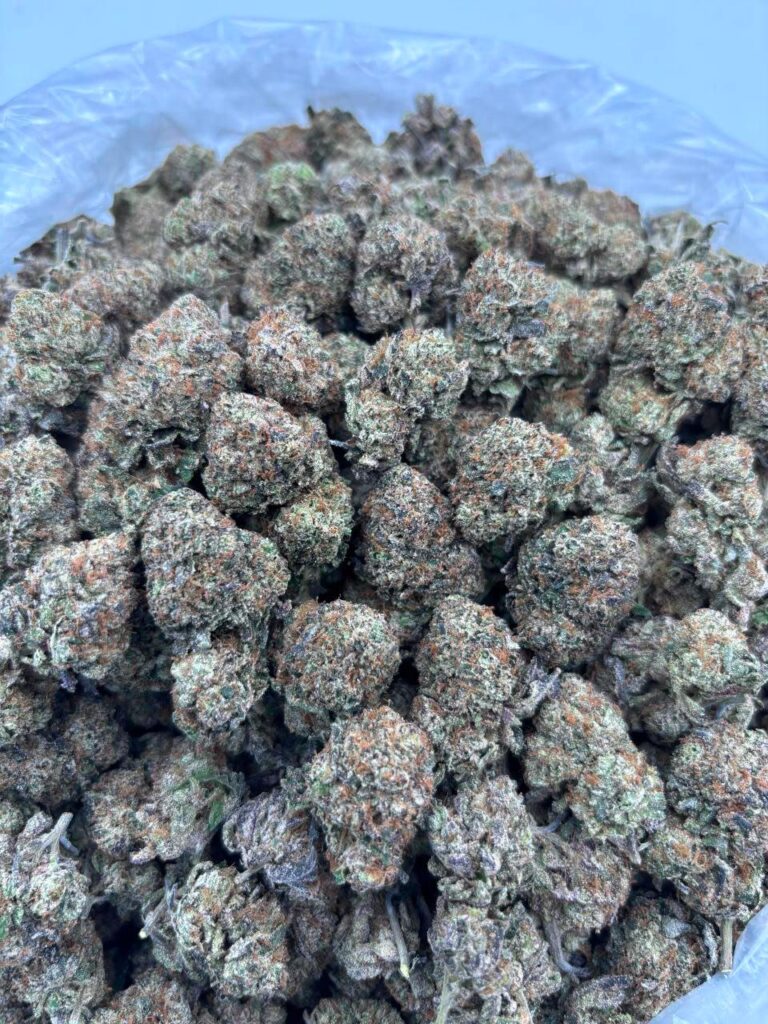
The result finishes in 58 to 63 days, grows to a medium size, and does well indoors or outdoors (Seed-City). Flavor-wise, people describe it as creamy hazelnut ice cream mixed with sweet gas, which tracks exactly with what you’d expect from these two parents (Linda Seeds). One dispensary that carries this cut describes the bud structure as mid-sized and tightly packed, with a vibrant blend of green shades, deep purple undertones, and bright orange pistils running through it (Tokersguide).
Let’s meet these parents, because both of them are genuinely famous in their own right.
Meet Bacio Gelato (Gelato 41)
Bacio Gelato is a specific phenotype of Gelato, bred by Sherbinski’s, the same breeder credited with the original Gelato line. The name “Bacio” is Italian for “kiss,” borrowed from a famous Italian chocolate hazelnut treat, which tells you a lot about the flavor before you even smell it (EastTreeCBD).
Here’s a wild fact: Abstrax Tech, working directly with Sherbinski’s, tested tens of thousands of strains for volatile sulfur compounds (the stuff behind that skunky, gassy smell), and Bacio Gelato came out on top. Not close to the top. On top, with sulfur compound levels nearly double the previous record holder (Abstrax Tech). So if a strain in this family tree smells like it could strip paint off a wall, Bacio Gelato is very likely the reason why. 💨
Bacio Gelato itself comes from Gelato, which is Sunset Sherbet crossed with Thin Mint Girl Scout Cookies. Sunset Sherbet brings the creamy, fruity sweetness and a relaxing body effect. Thin Mint GSC brings a minty, cookie-dough funk and a euphoric head high (TryCannavine). Gelato as a whole is basically credited with kicking off the entire modern “dessert weed” trend, and its popularity is a big reason Leafly started their Strain of the Year award in the first place (Abstrax Tech).
And since Thin Mint GSC traces back to Girl Scout Cookies, which is OG Kush crossed with Durban Poison, you can already see OG Kush sneaking back into this branch too, just through a completely different door than Branch One did (Weed.com).
Meet Runtz
Runtz might be the single most culturally important strain of the last decade, so it deserves its own spotlight here. It’s a cross of Zkittlez and Gelato #33, first dropped by Ray Bama and Yung LB at the Emerald Cup in 2017, where they reportedly sold five pounds of flower in under ten minutes (SeedFinder). It was then picked up and commercialized by the Cookies brand, and it went on to win Leafly’s Strain of the Year in 2020 (Stoops NYC, Abstrax Tech). The name comes from Runts candy, and the flavor lives up to it: tropical, sweet, citrusy, with a creamy finish.
Since Runtz already contains Gelato as one of its own parents, and Bacio Gelato is a Gelato phenotype, this branch of the candy gas family actually has Gelato genetics coming in from two directions too, similar to how Branch One doubled down on OG Kush. That’s a pattern you’ll notice a lot once you start mapping these trees out. Breeders often reinforce one flavor family by crossing it back into itself from a different angle, kind of like adding more of the same paint color to make it pop even harder (SeedCellar).
Runtz’s other parent, Zkittlez, deserves its own section too, because it shows up in more than one branch of this family tree.
Meet Zkittlez
Zkittlez is an indica-leaning hybrid bred from Grape Ape, Grapefruit, and a third undisclosed strain. It was originally nicknamed “Gas Station Bob” by breeders Terp Hogz and 3rd Gen Family Farms before it got the Zkittlez name, and it won first place at the 2016 Emerald Cup (SeedFinder). It’s known for a candy-sweet, fruity smell and high levels of limonene and caryophyllene, the same two terpenes that show up constantly across this whole family tree (SeaweedDelivery).
Grape Ape, one of Zkittlez’s parents, most likely traces back to Granddaddy Purple, itself a cross of Purple Urkel and Big Bud. Big Bud traces further back to Afghani landrace genetics from Neville’s old breeding stock (SeedFinder). So even a strain as candy-sweet as Zkittlez has old-school indica landrace roots buried a few generations down, the same kind of deep Afghan ancestry that shows up on the OG Kush side of this tree too. Two completely different-tasting branches of the candy gas family, and both of them lead back to Afghan hills eventually.
Branch Three: Zkittlez x (Mendo Breath x Jet Fuel Gelato)
A few dispensary blogs describe a completely different Candy Gas, built from Zkittlez crossed with a combination of Mendo Breath and Jet Fuel Gelato (HighThere). Notice that Zkittlez shows up here too, which means this branch and the Grounded Genetics branch actually share one grandparent even though the rest of their family trees look completely different. Genetics are weird like that. 🧬
Mendo Breath is an indica-heavy strain known for a doughy, sweet smell and heavy, relaxing effects. It’s often used as a building block in other “candy gas” style crosses, including one called Forbidden Zkittlez, which combines Forbidden Fruit, Mendo Breath, and Zkittlez into a berry-and-fuel hybrid with a similar flavor goal (Strainpedia). That strain tests between 17% and 22% THC and is described as having a dark berry, sweet fruit smell with a subtle fuel undertone underneath it, which should sound familiar by now.
Jet Fuel Gelato is exactly what it sounds like: a cross of Gelato genetics with a Jet Fuel line, most commonly described as High Octane crossed with Jet Fuel, which brings that sharp, mechanic-shop diesel smell into the mix (Leafly). One strain reviewer described smoking a similar Zkittlez-and-Jet-Fuel-Gelato cross and immediately noticing the “Jet Fuel OG” hit on the exhale, even under all the candy sweetness on top (The Highest Critic).
So this branch is basically candy on top, fuel on the bottom, twice over, since both Zkittlez and Jet Fuel Gelato contribute their own version of sweetness, and Mendo Breath and Jet Fuel Gelato both contribute their own version of gas.
Branch Four: Candy Kush x “A Gassy Indica-Dominant Hybrid”
The fourth version is the vaguest one, and I want to be upfront about that instead of pretending it’s more solid than it is. One retailer describes their Candy Gas as a cross between Candy Kush and an unnamed gassy indica hybrid, with some cuts reportedly tracing back through Zkittlez or Runtz depending on which grower you ask (Candy Gas Strain Clinic).
Candy Kush here likely refers to the same Kandy Kush lineage from Branch One (OG Kush x Trainwreck), since that’s the most common strain that goes by both spellings (Joint Commerce). But without a named second parent, this branch is really more of a flavor promise than a documented genetic cross. It’s a good example of how “Candy Gas” sometimes gets used as a marketing shorthand rather than an actual, traceable lineage. I’d treat any Candy Gas cut sold this way as unverified until the seller can point to real parent names.
The Whole Family Tree, Laid Out
Here’s the tree mapped out so you can see it all in one place. I find this way easier to follow than paragraphs alone. 🗺️
| Branch | Bred by | Direct Parents | Grandparents |
|---|---|---|---|
| 1 | Crockett Family Farms | Kandy Kush x OG #18 | OG Kush x Trainwreck (Kandy Kush side); OG lineage (OG #18 side) |
| 2 | Grounded Genetics | Bacio Gelato (Gelato 41) x Runtz | Sunset Sherbet x Thin Mint GSC (Bacio side); Zkittlez x Gelato #33 (Runtz side) |
| 3 | Unnamed / dispensary reports | Zkittlez x (Mendo Breath x Jet Fuel Gelato) | Grape Ape x Grapefruit (Zkittlez side); Gelato x Jet Fuel (Jet Fuel Gelato side) |
| 4 | Unnamed / retailer claim | Candy Kush x unnamed gassy indica | Likely OG Kush x Trainwreck (Candy Kush side) |
Look at how many times a handful of names repeat across all four branches: OG Kush, Gelato, Zkittlez, Trainwreck. That repetition isn’t a coincidence. It’s basically the DNA of an entire cannabis era. Almost every “exotic” strain released in the last ten years traces back to some combination of these same four or five foundational lines. Candy Gas, in any of its versions, is really just one more branch on a much bigger tree that includes Runtz, Gelato, GSC, and dozens of other household names. 🌱
Going One Level Deeper: The Grandparents That Built This Whole Category
I want to slow down here, because I think this is the part that actually explains why the candy gas family tastes the way it does, no matter which branch you end up with.
Girl Scout Cookies deserves a callout on its own, since it’s the grandparent (or great-grandparent) hiding behind both Kandy Kush’s OG side and Bacio Gelato’s Thin Mint side. GSC was created in the Bay Area from OG Kush crossed with Durban Poison, and it’s credited with being the strain that first combined heavy gas genetics with a softer, doughy, dessert-like flavor, years before Gelato or Runtz existed (Breeders Collective). Some earlier accounts describe it as Florida Kush crossed with an F1 Durban cut (Nuggnotes), but every version agrees on the same basic idea: OG genetics plus a sativa for lift and sweetness.
That “gas plus dessert” formula GSC pioneered is, in a lot of ways, the actual blueprint the entire candy gas family is following, just with newer parent strains standing in for the older ones. GSC did it first with OG Kush and Durban Poison. Runtz did it again with Gelato and Zkittlez. Candy Gas is doing it a third time with whichever pair of candy and gas strains a given breeder picked. Once you see this pattern, you can’t unsee it. Cannabis breeding over the last fifteen years has basically been one long remix of the same “sweet dessert plus heavy gas” idea, wearing a new name every couple of years.
Durban Poison is a pure sativa landrace from South Africa, and it’s the genetic source of the sharp, sweet, almost licorice-like top note you get in GSC and its descendants. It’s one of the few strains in this whole tree with a genuinely clean, well-documented origin, since landrace strains grow wild or semi-wild in one region for generations before anyone crosses them with anything else.
Trainwreck shows up twice in this story, once directly in Kandy Kush and once indirectly through the broader OG family, and it’s known for its speedy, cerebral effect and citrus-pine smell.
Chemdawg is worth one more mention, because even though it’s not a direct parent in any Candy Gas branch, it’s the strain most responsible for the entire “gas” aesthetic that half this family tree is built around. Chemdawg is also the ancestor of Sour Diesel, which basically invented the diesel-fuel flavor lane that OG Kush, GMO, and countless other gas-forward strains have been building on ever since (Joint Commerce).
So when you zoom all the way out, the candy gas family tree really has two rival bloodlines feeding into it from opposite directions. One side, Chemdawg, Hindu Kush, OG Kush, Trainwreck, built the entire “gas” half of the flavor equation. The other side, Grape Ape, Grapefruit, Durban Poison, Sunset Sherbet, built the “candy” half. Every Candy Gas cross, no matter which breeder made it, is really just a new attempt at balancing those same two old rival flavor camps. I think that’s a genuinely cool thing to know before your next bowl or dab. 🌿
Meet the Cousins: Other Strains Sharing This Same Family Tree
Once you know the candy gas family’s real parents, you start recognizing its cousins everywhere. This isn’t just a fun side note, it’s actually useful, because if you like one strain in this section, there’s a good chance you’ll like the others too.
GMO Cookies (also called Garlic Cookies) is Chemdawg crossed with GSC, uniting Chemdawg’s diesel-funk power with GSC’s dessert-sweet complexity. Phenotypes frequently test between 22% and 30% THC, among the stronger offerings in this whole extended family (Joint Commerce).
White Runtz is a stabilized selection of the same Zkittlez x Gelato genetics behind Runtz, delivering 23-26% THC with a terpene profile leaning into limonene, caryophyllene, and linalool, the exact same trio we’ve talked about all through this article (SeaweedDelivery).
Purple Runtz is a direct phenotype of the original Runtz cross, selected specifically for deeper purple coloring and a more prominent grape-and-berry terpene lean (SeedsHereNow).
Rainbow Runtz traces to a cross between Zkittlez and DoSiDos rather than Runtz itself in most accounts, which makes it a half-sibling of sorts, sharing the Zkittlez side but not the Gelato side (Valley Greens).
Gelatti brings Biscotti into the Gelato lineage, adding a nutty, baked quality on top of the standard fruit-and-fuel Gelato profile (Abstrax Tech).
Lemon Cherry Gelato is Sunset Sherbet crossed with Girl Scout Cookies, taking Gelato’s usual gas-dominant reputation and pushing it toward a brighter, citrus-forward expression instead (Abstrax Tech).
Tractor Fuel, bred by Mendoja Farm, is Zkittlez crossed with Gas Pedal OG, another completely separate breeder chasing the exact same candy-and-fuel combination through yet another pairing (GetSeedsRightHere).
Seeing this list laid out, you start to realize Candy Gas isn’t some rare, isolated experiment. It’s one entry in a huge, ongoing project the entire cannabis breeding world has basically been running together for over a decade: take a candy strain, take a gas strain, cross them, name the result something sweet and aggressive, repeat.
Why It Smells Like Candy and Gas at the Same Time (The Terpene Explanation)
This is the part where I get a little nerdy, because the smell isn’t random, it’s chemistry, and once you understand the basics, you’ll be able to guess a lot about a strain just from the label.
Limonene is a terpene found in citrus peels, and it’s a big part of why so many strains in this family smell sweet and bright. It shows up heavily in Zkittlez, Kandy Kush, and most Gelato phenotypes (Joint Commerce).
Caryophyllene is the terpene also found in black pepper, and it’s the main driver of that spicy, fuel-adjacent, gassy backbone. It shows up in basically every OG-lineage strain in this tree, plus Runtz and Gelato (SeaweedDelivery).
Linalool brings a floral, almost lavender-like note, and it shows up more in the candy-leaning branches, softening the sharper edges of caryophyllene.
Myrcene shows up across the OG Kush and GSC side of the tree, adding earthiness and contributing to that heavy, sedating body feel a lot of these strains share.
Ocimene pops up in some of the sweeter, more floral phenotypes, adding a light, herbal top note on top of the fruitier terpenes.
And then there’s the sulfur compound story from Bacio Gelato, which isn’t a classic terpene but is a huge part of why that specific branch of the candy gas family smells so aggressively gassy. Abstrax Tech’s research found these sulfur compounds are what actually give a lot of modern “gas” strains their skunky punch, separate from the terpenes doing the sweet, fruity work (Abstrax Tech).
Put simply, the candy half of the name usually comes down to limonene and linalool, and the gas half usually comes down to caryophyllene, myrcene, and (in the gassiest cuts) those sulfur compounds. When a breeder crosses a candy-heavy strain with a gas-heavy one, you’re really just combining two different terpene recipes into one plant, and depending on which parent’s genes come through stronger in a given seed, you get a slightly different balance every time. That’s also why phenotype hunting matters so much with these crosses. Ten seeds from the same Candy Gas pack can smell noticeably different from each other. 🔬
Phenotype Hunting: Why Every Pack Is a Little Bit of a Lottery
Since we’re already talking about phenotypes, it’s worth explaining this properly, because it explains almost every confusing review you’ll ever read about this strain family.
When a breeder crosses two plants, like Bacio Gelato and Runtz, they don’t get one uniform result. They get a batch of seeds, and every single seed carries a slightly different combination of genes from both parents. Grow ten of those seeds side by side and you’ll get ten plants that look, smell, and taste at least a little different from each other. Breeders call these variations phenotypes, or “phenos” for short.
Most breeders grow out a big batch, then pick the one or two plants that best match what they were going for. That winning plant gets turned into a “cut,” which is then cloned over and over so every future plant is a genetic copy of that one specific winner. This is why you’ll sometimes see a strain listed with a name like “Plush cut” or “TSB cut” next to Candy Gas. Those aren’t different strains, they’re different individual selections from the same original cross, each hunted out and preserved by a different grower (Herb.co).
That also explains the mixed reviews we covered earlier. A grower running seeds instead of a stabilized clone might end up with a plant that leans hard into the gas side and barely shows any candy sweetness at all, even though it technically has the exact same parents as a friend’s plant that turned out sweet and fruity. Neither grower is wrong. They just got different rolls of the genetic dice.
What People Actually Say After Smoking It
I don’t love strain guides that only quote marketing copy, so let’s look at what real smokers are saying across a few different platforms.
On Leafly, one reviewer described the smell hitting them the second the jar opened, sweet candy up front with a heavy gassy backend, and said the effects came on fast with a head change before settling into a relaxed body high that didn’t fully knock them out (Leafly). Another reviewer, someone who said they usually don’t like 50/50 hybrids, called out the fruity taste and a smell so strong they noticed it before opening the jar all the way.
Over on Reddit, according to Herb’s roundup of community threads, a reviewer in r/CanadianCannabisLPs smoked a Plush cut (listed as Kandy Kush x OG Kush) and called it some of the smoothest smoke they’d had in a long time (Herb.co). A grower posting in r/macrogrowery said their purple Candy Gas plants came out deep purple, candy-sweet, and gassy, and joked that the bag sells itself just off looks and smell alone. Not every review was glowing, though. A reviewer in r/THCaFlower rated a TSB cut 7.5 out of 10, saying the nose was loud and skunky but they barely picked up any actual candy sweetness, and the buds fell apart a little too easily when squeezed.
That mixed bag is honestly the most useful thing I can tell you about this strain family. The gas and the potency show up reliably almost every time. The candy sweetness and the bud density are a lot more hit-or-miss, and they depend heavily on which breeder’s version you’re smoking and how well that specific batch was grown (Herb.co).
Effects-wise, across most reports, people describe an initial mental lift (euphoric, creative, focused) that gradually turns into a physical, relaxed feeling without heavy couch-lock, at least at typical serving sizes (Kush Mintz). That balanced pattern makes sense once you know the lineage, since almost every branch of this family tree pairs an uplifting sativa-leaning parent (Trainwreck, Zkittlez, or Gelato’s Sherbet side) with a heavier indica-leaning one (OG Kush or Mendo Breath). People commonly mention using it for stress, tension, and a general mood lift, though of course everyone’s body reacts a little differently, and none of this is medical advice.
THC, Terpenes, and Price: What to Expect
THC in the candy gas family usually lands in the low-to-mid 20% range, with some cuts pushing toward 26% (SeedsHereNow). Total terpene content on well-cured, top-shelf batches tends to run between 2% and 4% by weight, which is genuinely high for flower and part of why the smell hits so hard the moment you open the container (Joint Commerce).
Price depends a lot on where you’re shopping and which branch you’re getting. Top-shelf indoor batches sit in the premium tier because of how much work it takes to grow flower this frosty and this loud. One Reddit reviewer mentioned paying around $60 for a 7-gram bag before a discount kicked in (Herb.co). Budget or greenhouse-grown batches run cheaper, but usually trade some of that visual appeal and terpene intensity for a lower price point.
Growing Candy Gas: What Cultivators Report
If you’re thinking about growing any version of this strain, here’s what growers consistently mention.
It’s generally considered a moderate-to-advanced grow, not a beginner-friendly plant. It rewards tight environmental control and punishes neglect, especially around humidity, since dense, resin-heavy buds like these are more prone to mold if airflow isn’t dialed in (Herb.co).
Flowering time runs 58 to 70 days depending on which branch you’re growing, with the Grounded Genetics version finishing a bit faster than the Crockett Family Farms version (Seed-City, SeedsHereNow).
Growers recommend a moderate stretch expectation, roughly 1.5 to 2 times the plant’s pre-flower height, and low-stress training or topping tends to work well to build a flatter, more even canopy for better light penetration (SeedsHereNow).
Nitrogen should be kept conservative during mid-flower. Heavy nitrogen feeding tends to mute the gas notes people are growing this strain for in the first place, so cultivators lean toward dialing back nitrogen and pushing phosphorus and potassium instead for denser, more aromatic buds (Candy Gas Strain Clinic).
Harvest timing matters more than usual here too. Waiting for at least 70% cloudy trichomes with a bit of amber tends to bring out the full relaxation effect, and harvesting too early reportedly mutes the gas smell before it fully develops (Candy Gas Strain Clinic).
A proper flush, 10 to 14 days before harvest, protects the terpene profile and helps that candy flavor come through cleanly instead of getting muddied by nutrient taste in the smoke.
Indoor growing tends to bring out this strain family’s best qualities. Mediterranean-style conditions, meaning warm days, dry air, and consistent light cycles, seem to be where these genetics are happiest, whether grown indoors under lights or outdoors in the right climate (SeedsHereNow).
Why This Family Is Also Big in Concentrates
I should mention this, because it’s a huge reason the candy gas family keeps growing in popularity, and it’s not just about smoking flower.
High resin content runs through almost every branch of this tree. Bacio Gelato is described as one of the most resin-heavy cultivars ever tested, Kandy Kush is prized by extraction artists for its sticky, trichome-loaded buds, and Runtz is known across the industry for a greasy, oily resin texture that makes it a favorite for solventless work like rosin and hash (Strainpedia, Strainpedia). That kind of resin output matters a lot to people pressing rosin or making live resin, since more trichome coverage generally means a better yield when you’re pulling concentrate out of flower.
The terpene intensity we talked about earlier also translates well into vape carts and dabs, since a lot of that loud smell and flavor survives the extraction process better in strains that start out terp-heavy in the first place. That’s part of why you’ll often see candy gas genetics show up on a dispensary’s concentrate menu, not just the flower shelf.
Trademarks, Knockoffs, and Why Names Get Messy
One more honest note before we get to the practical stuff. Cannabis strain names aren’t trademarked the way a lot of people assume. A breeder can put real work into stabilizing a cross, give it a catchy name, and then watch other growers slap that same name on a completely different plant within months, simply because there’s no enforceable system stopping them.
This happens constantly with popular flavor combos. Once “Candy Gas” started selling well for one breeder, it became an easy label for anyone else growing something in the same sweet-and-gassy lane, whether or not their plant shared any actual genetics with the original cross. I’m not saying every seller doing this is acting in bad faith. A lot of them probably believe they’re describing their flower accurately. But it does mean the name alone can’t tell you much, and it’s part of why this entire article exists in the first place.
Where Candy Gas Fits in the 2026 Market
The timing on this strain family isn’t an accident. Cannabis and hemp shoppers in 2026 are leaning hard into what a lot of industry writers now call “dessert gas,” meaning strains that combine a sweet, dessert-like top note with a heavy, fuel-forward finish underneath (LuckyElk). That’s exactly the lane every branch of the candy gas family sits in.
This trend is showing up just as strongly in the THCa hemp flower market, which has grown enormously since 2024 and continues expanding through 2026 as more states clarify their rules around hemp-derived products. Some market analysis points to THCa flower sales growing by roughly 340% since early 2024, with demand still climbing (Hemp Flower Co.). Buyers shopping THCa flower are specifically searching for boutique, dessert-and-gas hybrids with high total terpene percentages, sometimes exceeding 4-5%, and unique color expression from anthocyanin pigments (that’s the purple and pink coloring you see in a lot of these strains) (Hemp Flower Co.). Candy Gas checks basically every box on that list.
Under current hemp rules, flower can legally test up to 0.3% delta-9 THC on a dry-weight basis while still carrying a high THCa percentage, since THCa itself isn’t intoxicating until it’s heated (Hurcann). That distinction is a big part of why so many hemp retailers are now selling Candy Gas-style genetics as compliant flower, even in states where traditional high-THC cannabis isn’t legal yet. Worth knowing, though: 2026 has also brought new federal and state attention to closing loopholes around hemp-derived intoxicating products, so rules in this space keep shifting and are worth double-checking in your own state before you buy (GanjaTrack).
Popularity roundups from mid-2026 keep naming Gelato, Runtz, and their descendants among the most in-demand flower categories on the market, driven by name recognition, sweet-and-gassy flavor cues, and strong shelf appeal (Vertex Exotics). Since the candy gas family draws directly from both of those lines, it’s riding the exact same wave, and I’d expect to see even more breeders release their own Candy Gas-branded crosses over the next couple of years as the category keeps growing.
How to Actually Verify You’re Getting Real Candy Gas Genetics
Given everything we just covered, here’s my honest advice if you’re shopping for this strain and actually care about the genetics behind it, not just the name on the label.
Ask which breeder’s version you’re buying. “Candy Gas” alone tells you almost nothing. “Grounded Genetics’ Candy Gas” or “Crockett Family Farms’ Gas Candy” tells you a lot, because now you know which parents you’re actually working with.
Check the lab report (COA) if one’s available. It won’t tell you the genetics directly, but a strong total terpene number, above 2%, ideally closer to 3%, is a decent sign the batch was grown and cured the way this strain family needs to actually taste like its name.
Look at the color and structure. Purple or violet hints, dense bud structure, and heavy trichome coverage line up with what growers report across every branch of this tree. Buds that fall apart easily when squeezed, or that smell mostly like gas with no candy at all, might still be a legitimate cut, just a phenotype that leaned harder toward one parent than the other.
Be a little skeptical of vague claims. If a seller can’t name at least one actual parent strain, treat it the way you’d treat Branch Four above: possibly a real Candy Gas descendant, but unverified until proven otherwise.
A Quick Glossary for This Whole Family Tree
Since a few breeding terms came up a lot in this article, here’s a fast rundown so none of it feels like jargon.
Landrace means a strain that developed naturally in one region over generations, without deliberate crossbreeding. Hindu Kush and Durban Poison are both landraces.
Pheno (phenotype) means one individual plant’s specific expression of a cross, since siblings from the same seed pack can look and smell different from each other.
Cut means a specific phenotype that’s been cloned and preserved, so every plant grown from that cut is a genetic copy of the original winner.
Reversal means forcing a female plant to produce pollen, usually through stress or a chemical spray, so a breeder can use that plant’s genetics on the male side of a cross without needing an actual male plant.
Terpenes are the aromatic oils in cannabis that create its smell and flavor, and they also seem to shape how the effects feel, working alongside THC and other cannabinoids.
A Quick FAQ on the Candy Gas Family 🍬
Is Candy Gas an indica or a sativa? Every documented branch of the candy gas family is a hybrid, usually close to a 50/50 split, sometimes leaning slightly indica depending on the specific cross and phenotype (Leafly, Candy Gas Strain Clinic).
What strain is Candy Gas actually a cross of? It depends which Candy Gas you’re holding. The two best-documented answers are Kandy Kush x OG #18 (Crockett Family Farms) and Bacio Gelato x Runtz (Grounded Genetics). Less documented versions point to Zkittlez x (Mendo Breath x Jet Fuel Gelato), or Candy Kush x an unnamed gassy indica.
Why does Candy Gas smell like fruit and fuel at the same time? Because its parent strains each carry different terpenes. Limonene and linalool create the candy-sweet, citrus, and floral notes. Caryophyllene, myrcene, and (in some cuts) high sulfur compound levels create the gassy, fuel-like backbone.
Does Candy Gas get you really high? Most cuts test between the low-20s and mid-20s in THC percentage, which is solidly potent by modern standards, and total terpene content often runs 2-4%, adding to the intensity of the experience even beyond the raw THC number.
Is Candy Gas hard to grow? Growers generally describe it as a moderate-to-advanced plant. It rewards tight environmental control, conservative nitrogen feeding, and patience at harvest, and it punishes rushed grows with a muted flavor.
Is Candy Gas the same strain as Gas Candy? Sometimes, but not always. Crockett Family Farms’ cross is listed under both names depending on the source, so always check the named parents before assuming two listings are the same plant.
Which branch of the candy gas family should I try first? If you want the heavier, more OG-leaning experience, look for the Crockett Family Farms cross (Kandy Kush x OG #18). If you want something creamier and more dessert-forward with a wilder terpene profile, look for the Grounded Genetics cross (Bacio Gelato x Runtz). Both are solid starting points, they just lean toward different sides of the candy-and-gas spectrum.
A Note on How I Put This Together
I want to be transparent about something. A lot of strain guides online just repeat whatever the first three search results say, without checking if those results even agree with each other. For this article, I pulled directly from seed banks (Crockett Family Farms, Grounded Genetics, and their retailers), strain databases (Leafly, Weedmaps, AllBud, SeedFinder, Strainpedia), breeder history sites, and actual grower and smoker reviews from Reddit threads and dispensary review pages. Where sources disagreed, like whether Candy Gas comes from Kandy Kush and OG #18 or from Bacio Gelato and Runtz, I told you both, instead of quietly picking whichever one sounded more official. That’s the only honest way to write about a strain name this contested.
The Bottom Line
If there’s one thing I want you to walk away with, it’s this: the candy gas strain you bought last month and the candy gas strain your friend bought last week might genuinely be two different plants wearing the same name tag. That’s not a scam, and it’s not even really anyone’s fault. It’s just how strain naming works once a flavor combo gets popular enough that multiple breeders chase it independently.
But once you trace the branches back, something cool happens. You start seeing the same handful of legendary strains, OG Kush, Zkittlez, Gelato, Girl Scout Cookies, showing up over and over, feeding into different corners of this same family. The candy gas family isn’t really a strain. It’s a meeting point, the spot on the map where cannabis’s two biggest flavor movements (candy and gas) keep colliding, generation after generation, breeder after breeder.
Next time you crack open a jar labeled Candy Gas, take a second before you grind it up. Smell it. See which side wins, the sugar or the fuel. Now you actually know why. 🌿🍬⛽
